Two woodcutters at a river crossing
In his preface to Kwaidan, Lafcadio Hearn distinguishes Yuki-onna from stories drawn out of old books. He says that a farmer from Chofu in the Nishitama district told it as a legend of his native village. The narrative itself is set in Musashi Province without an exact year. The elderly Mosaku and his eighteen-year-old apprentice Minokichi go to the forest to cut wood, crossing a broad river on their daily journey. When an exceptional snowstorm overtakes them, the ferryman has departed and his boat lies on the opposite bank. The men shelter in a cramped hut without a hearth, secure its door and cover themselves with straw raincoats.
A visitor brought by snow
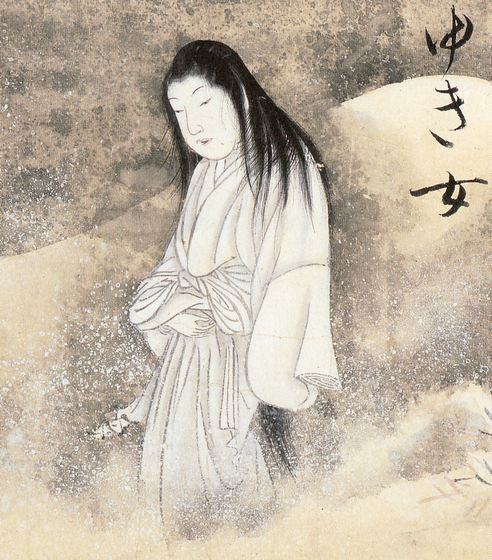
Minokichi wakes in the night with snow falling on his face. The door is open and a woman dressed in white bends over Mosaku. Her breath resembles luminous smoke. She approaches the younger man, who wants to cry out but cannot. Because he is young and attractive, she decides to spare him. However, he must never tell anybody what he has witnessed, not even his mother. If he breaks the prohibition, she will know and kill him. After her departure he braces the door with pieces of wood. He wonders whether he dreamed the encounter or mistook reflected snowlight for a woman. Mosaku, however, lies cold and unresponsive: within the story the old man has died.
Making a family with a woman named Snow
The returning ferryman discovers Minokichi unconscious beside his companion’s body. The young man remains ill for a long time, eventually resumes his work and tells nobody about the vision. The following winter he meets the beautiful O-Yuki on the road home. She says that her parents have died and that she intends to seek employment through relatives in Edo. Minokichi invites her to rest at his house. His mother welcomes the visitor, acquaintance develops into marriage and ten children are born. O-Yuki remains unusually youthful in appearance. The narrative moves away from the storm into ordinary domestic life, apparently separating the terrifying encounter from the happy household by many years.
Words beside the lamp
One evening Minokichi watches his wife sewing by lamplight. Her appearance reminds him of the woman in the hut, and he finally relates the forbidden story. O-Yuki changes and declares that she herself spared him that night. He has broken his promise. Although she could now kill him, she refrains for the sake of their sleeping children. She orders him to care properly for them and threatens punishment if he mistreats them. Then she becomes white mist and disappears through the smoke opening. Hearn ends with her departure, rather than a subsequent capture of the being or a definitive explanation of its nature.
Comparing the printed account and its frame
The text contains both a supernatural explanation and Minokichi’s own uncertainty about the initial vision. Museum materials describe Hearn’s work as literary reworking of Japanese traditions, while a biographical page supplies context about the author. These pages do not independently establish the family in the narrative. Geography also requires care: Hearn’s stated source does not make every present-day place sharing its name a possible incident site. The historical province is retained without assigning a precise address. Publication of the collection likewise supplies no year for the snowstorm, marriage or disappearance.


