An object already leaving
On 19 October 2017 the Pan-STARRS1 telescope in Hawaii detected a faint moving object. It had already passed its closest point to the Sun and was departing. Further measurements revealed an unusual orbit: the body did not belong to the normal population gravitationally bound to the Sun. It had arrived from interstellar space and would leave again. It received the designation 1I/2017 U1 and the name Oumuamua.
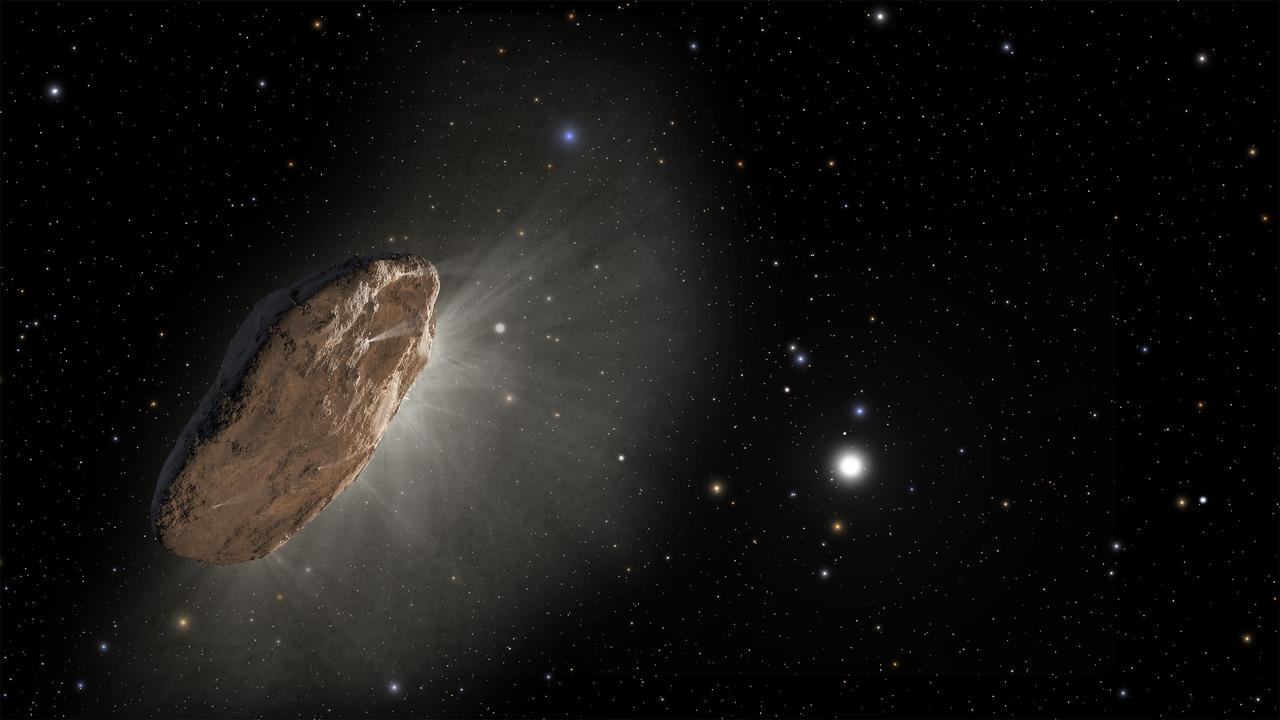
Astronomers rapidly involved other observatories while the source remained accessible. Time was limited because its brightness declined as distance increased. No spacecraft approached its surface. Familiar pictures of an impressive cigar-shaped body are reconstructions rather than resolved photographs. In telescopes it remained a point of light, with physical properties inferred indirectly.
Brightness and color
Observations revealed substantial brightness changes during rotation and a reddish color. The light curve's large amplitude indicated unusual proportions or a combination of shape and surface properties. Converting those measurements into three-dimensional geometry requires a model, however. A thin elongated rock is an interpretation, not a directly measured outline. Researchers also considered other shapes and complex rotational motion.
Early descriptions moved between comet and asteroid because a conventional bright coma was not observed. The absence of a conspicuous dust envelope constrained familiar activity explanations without turning the body into a technological device. Observational limits must be distinguished from a claim that gas could never escape its surface. Faint or unusual material loss could remain below instrumental sensitivity.
The additional acceleration
In 2018 Marco Micheli and colleagues published trajectory analysis including a small non-gravitational acceleration. Comets can experience additional forces when they release gas, but this case required reconciling acceleration with missing conventional activity signatures. The unusual combination prompted natural models involving composition, structure and surface behavior. Each must address the full set of constraints rather than one appealing effect.
Shmuel Bialy and Avi Loeb examined sunlight pressure acting on an extremely thin body and discussed an artificial-origin possibility. Calculating a possible force is not the detection of a spacecraft. In 2023 Jennifer Bergner and Darryl Seligman proposed a natural model releasing hydrogen accumulated in water ice through cosmic irradiation. This is a physical hypothesis with assessable assumptions, not a chemical analysis of a recovered Oumuamua sample.
Comparing established and inferred properties
The interstellar passage is securely established. Exact shape, composition and the additional acceleration mechanism are inferred from a limited sequence of remote observations. Their uncertainty allows scientific comparison between models but does not establish extraterrestrial technology. No Earth map point is assigned to the object itself: the Hawaiian telescope was the discovery location, not a terrestrial incident involving the body. This distinguishes the record from a meteorite fall with recovered material, where laboratory measurements can supplement the original sky observations and test composition directly.