Friday night above football grounds
On the evening of 9 October 1992 a brilliant fireball crossed the eastern United States. Many people were attending high school football games, and some already had video cameras running. The celestial event was therefore recorded from several locations without a prearranged scientific network. Amateur footage preserved the motion of the luminous body and its fragments, later supplying data for reconstructing its atmospheric path.
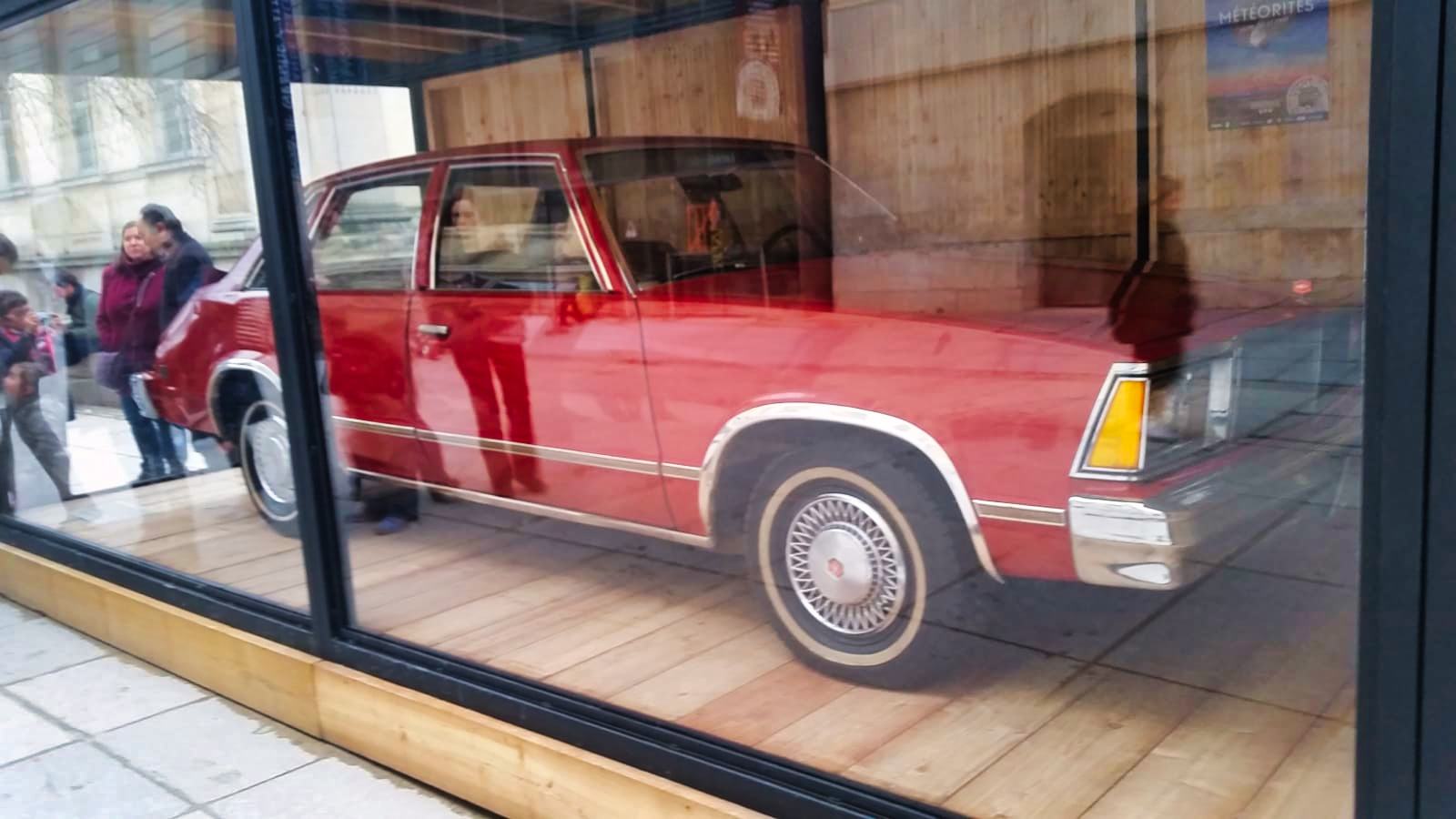
In Peekskill, New York, one surviving stone ended its flight conspicuously. It struck a parked Chevrolet Malibu, pierced the trunk area and came to rest beneath the vehicle. The owner was Michelle Knapp. This unusual damage connected the sky spectacle with a terrestrial object that could be inspected, photographed and preserved together with the discovery account.
The stone beneath the car
The Meteoritical Bulletin records Peekskill as an observed fall with a recovered mass of about 12.57 kilograms. This is a measurement of recovered material rather than an estimate based on the size of a luminous cloud. The American Museum of Natural History describes the crash, punctured trunk and dent in the ground beneath the car. The final part of the flight left inspectable physical traces.
A specimen separates this case from an account that something merely fell from the sky. Specialists could examine its minerals, prepare sections and compare results with known meteorites. Its dark exterior relates to heating during atmospheric entry. It does not mean that the entire interior melted or that the stone continued shining on the ground.
Connecting ground and sky
Recordings from different directions allowed investigators to compare the fireball with horizons and recognizable reference points. Such reconstruction requires camera locations and image characteristics, rather than simply joining bright points across several videos. The International Meteor Organization discusses Peekskill as an example of using video to investigate meteoroid fragmentation and meteorite falls. Its scientific value consequently extends well beyond the memorable vehicle damage.
Laboratory classification identifies an ordinary H6 chondrite. Ordinary describes the meteorite class and does not make a car strike commonplace. The designation relates to composition and the degree of modification on a parent body before arrival at Earth. Recovered mass is likewise not the original incoming mass: material fragmented, dispersed or vaporized during the bright atmospheric phase.
Comparing kinds of evidence
Several independent strands converge here: fireball sightings, video recordings, an impact location, a damaged car and a studied specimen. Each contributes a different part of the history, together supporting a secure natural explanation. The map uses city-level coordinates for Peekskill; a private street address is unnecessary for understanding the event. Unlike a light anomaly leaving no residue, this fireball supplied physical material that can be studied decades after its luminous trail disappeared. The connection between the recordings and the recovered stone makes it a particularly useful documented fall.