A night fall over Chihuahua
Early on 8 February 1969 a brilliant fireball crossed northern Mexico. Around one in the morning, residents near Pueblito de Allende in Chihuahua witnessed the luminous event before numerous stones reached the ground. Atmospheric fragmentation produced an extended strewn field rather than a single impact point. Researchers could therefore compare many fragments belonging to the same incoming object.
A detailed Smithsonian report describes the direction of travel and distribution of discoveries. Smaller and larger stones occupied different parts of a region encompassing several settlements and ranches. Such a map records fragmentation and subsequent movement through the atmosphere. It is not the outline of one crater, whose existence is not required by a spectacular fireball.
Scientists and schoolchildren
Within days, Smithsonian researchers Brian Mason and Roy Clarke arrived in Mexico. The institutional archive describes local schoolchildren helping to search in exchange for soft drinks. A nearby mining company also assisted. The resulting scientific collection depended on professional interest, local knowledge and many people able to examine the ground soon after the fall.
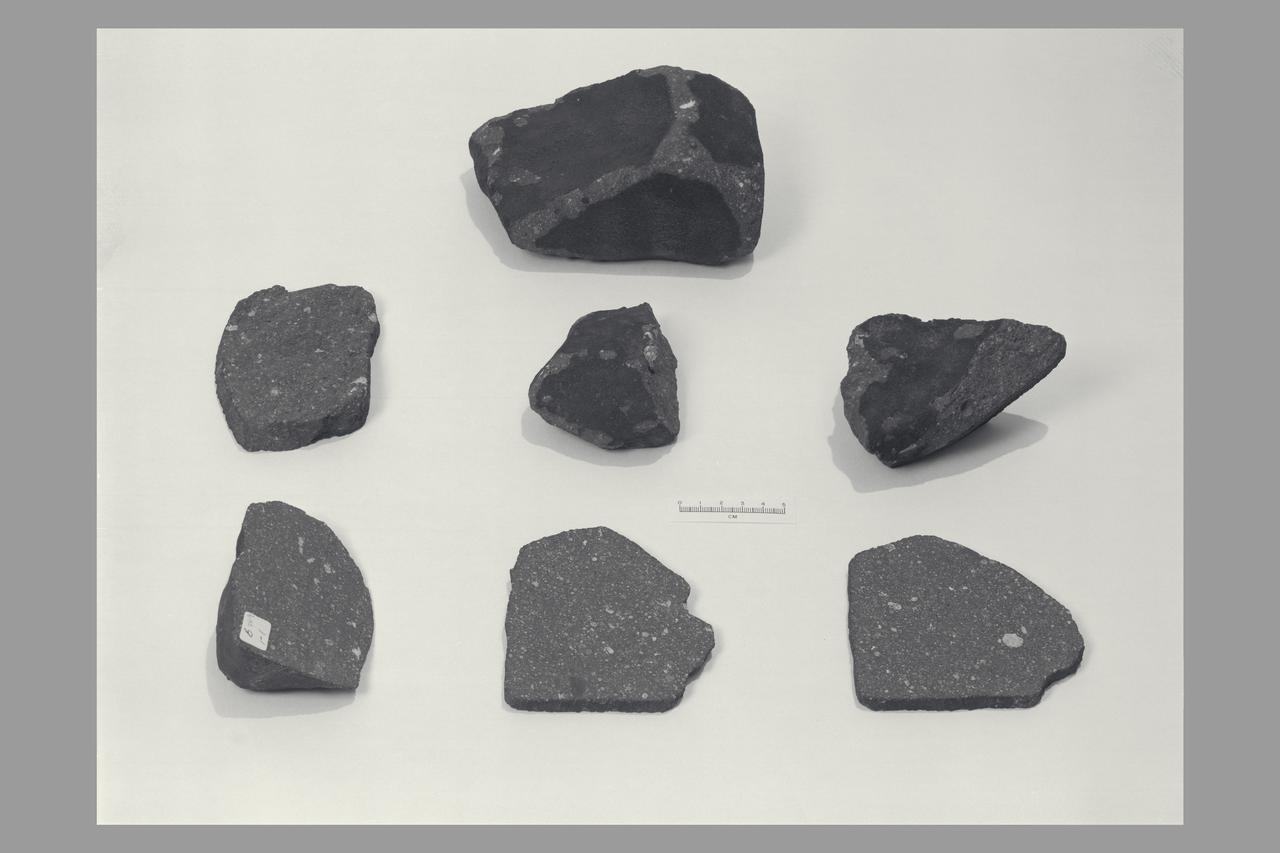
More than a ton of material was recovered, ranging from tiny pieces to very large stones. Rapid collection limited terrestrial weathering, while abundance enabled distribution among laboratories. Allende subsequently became one of the most familiar objects in meteoritics. Available quantity did not remove the need to document each specimen's provenance and distinguish it from unrelated local rocks.
What the interior revealed
The fragments carried dark fusion crust formed during atmospheric entry. Inside lay fine matrix, rounded chondrules and pale inclusions rich in calcium and aluminum. Allende is a carbonaceous chondrite of the CV group. Its composition and structure preserve information about early Solar System processes, before the modern planets had acquired their familiar form.
The refractory inclusions proved particularly important. Their minerals and isotopic relationships are used to reconstruct very early events. The age of the material must be separated from the date of its arrival on Earth: ancient components did not originate in February 1969. That date marks the end of the fragments' space journey and the beginning of their human study. Laboratory results answer different questions from eyewitness descriptions of the night sky.
Comparison with unexplained lights
Allende supplies a complete chain from observed fire to recovered material, museum curation and repeated analysis. Unlike an isolated sky photograph, the physical basis of its explanation can be checked by examining specimens. The generalized map point denotes the fall region rather than the address of an individual stone. The night spectacle was brief, but discovery continued in the field, collections and laboratories, where different investigators could work on portions of the same fall. This continuity between witnesses and material evidence is what gives the case its unusual historical and scientific strength.