A man inside an extraordinary title
A London pamphlet of 1590 announced itself as a true account of the life and death of Stubbe Peeter, supposedly a man who had killed in wolf form for twenty-five years. Catalogues and later accounts also call him Peter Stumpp or Peter Stumpf. Its setting is Bedburg and the area near Cologne. The title already supplied an execution date: the last day of October in the preceding year. It also claimed translation from a German publication brought to England by George Bores. Before readers encountered the details, they were offered both a monstrous criminal and assurances that the report could be trusted.
A belt explaining two appearances
According to the pamphlet, Peter entered a relationship with the devil when young and received a belt. Wearing it supposedly changed him into a huge wolf with burning eyes, a broad mouth and powerful paws. Removing it restored his ordinary human appearance. This device allowed the narrator to connect two incompatible pictures: a respectable-looking neighbour walking familiar streets, and a predator hiding in fields to attack people and livestock. The text attributes killings of adults and children, cannibalism and sexual crimes to him. These must remain allegations within a printed source, rather than a modern reconstruction with an independently verified list of named victims.
Capture and confession
In the English version, pursuers with dogs corner the wolf. Peter allegedly removes the belt and stands before them as a human being, after which he is arrested. Retellings that introduce a severed wolf’s paw corresponding to a suspect’s missing hand combine another version with this scene. The pamphlet proceeds to describe a confession under threat of the rack. By calling it voluntary while simultaneously describing coercive circumstances, the author creates an obvious evidentiary problem. The surviving account cannot reconstruct the interrogators’ questions, verify every attributed statement or separate actual animal attacks from crimes a community might have assigned to one accused person.
The execution and its warning monument
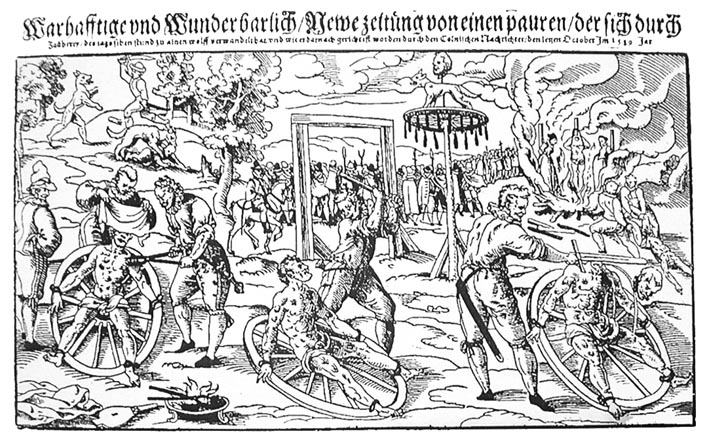
The execution is dated 31 October 1589. The printed account describes breaking on the wheel, decapitation and burning; two women represented as accomplices were executed alongside Peter. His head and the wheel were then displayed on a pole near an image of a wolf, with markers referring to the victims in the accusation. This installation extended the narrative beyond the execution. A passer-by was meant to see a warning against monstrous behaviour, rather than simply a punished individual. Broadsheet images and the extended English text circulated the scene far beyond the town. Both official violence and the techniques used to make its story memorable are historically significant.
Comparing the pamphlet, catalogue and research
Wellcome Collection establishes the edition’s bibliography and notes that its claimed original has not been traced. The digitised pamphlet permits its author’s rhetoric to be read directly. A research article compares German and English versions in which details differ; none of these publications supplies a complete surviving court transcript. The year filter identifies the reported execution rather than the subsequent English printing. A person’s death and contemporary belief in werewolves remain separate historical questions. Neither the belt story nor a confession obtained under threat of torture establishes a physical transformation into a wolf.


