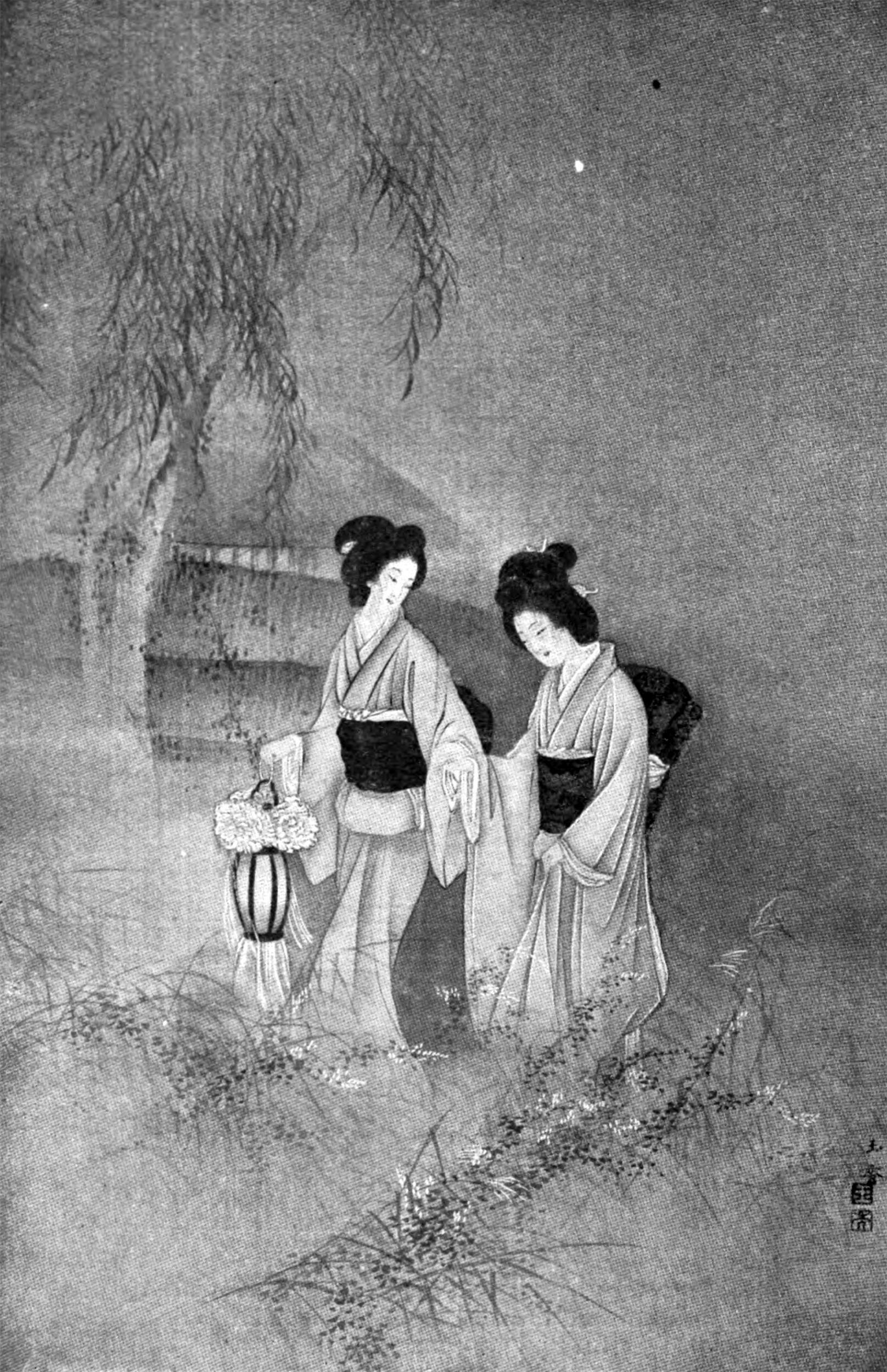
A meeting interrupted by somebody else’s fear
In In Ghostly Japan, Lafcadio Hearn explains the origin of A Passional Karma. After seeing The Peony Lantern performed, he worked with a helper to retell the supernatural portion of Encho’s romance. In this version, the samurai’s daughter O-Tsuyu lives separately with her devoted servant O-Yone. The family physician introduces the young Hagiwara Shinzaburo. The pair fall in love and pledge themselves to one another. However, the doctor fears the girl’s father and arranges no further meeting. O-Tsuyu interprets the silence as rejection, wastes away and dies; her servant dies soon afterwards. Shinzaburo learns this later, during his own illness.
Returning for the festival of the dead
The young man installs a memorial tablet, makes offerings and prays for his lost sweetheart. On the first evening of Bon he hears the approaching clatter of wooden sandals. O-Tsuyu and O-Yone pass his house carrying a lantern decorated with artificial peonies. Both sides express astonishment: the girl supposedly received news that Shinzaburo himself was dead. The apparent misunderstanding is resolved. The visitors stay until shortly before dawn and return on subsequent nights. To the samurai, their arrival restores his interrupted love. He conceals the visits from his inquisitive neighbour Yusai, a reader of fortunes through faces, and becomes increasingly attached to his sweetheart.
A servant watches through a crack
Tomozō, who serves the household, hears a woman’s voice and worries that somebody is deceiving his gentle employer. He peers through a crack in a shutter. At first he sees a youthful figure beneath the mosquito net, but then discovers the terrible truth about the embrace. Through Yusai, the matter reaches the priest Ryoseki. Shinzaburo himself searches for the women and finds their dwelling place in a cemetery. The priest supplies a protective amulet and sacred inscriptions for the house. These stop the nocturnal visitors outside. Love and fear struggle within the samurai, who hears O-Tsuyu weeping but cannot bring himself to remove the protection.
The price demanded by the living
O-Yone begins demanding Tomozō’s assistance and threatens him. His wife O-Mine proposes a profitable arrangement: a hundred ryo in gold would allow them to live without their employer. For that price Tomozō promises to remove an inscription and steal the amulet. While the samurai is bathing, the real golden image is replaced with a copper one and hidden in a field. The protective paper is removed from a little window, giving the ghosts access. In the morning the servant finds Shinzaburo dead, with a woman’s bones beside him and skeletal arms around his neck. Yusai notices the missing inscription and substitution. Ryoseki relates the ending to karma and directs that the young man be buried beside O-Tsuyu.
Comparing text, theatre and commemorative places
After the retelling, Hearn describes a visit to the cemetery and graves shown to him as those associated with the characters. That establishes an author’s account of a commemorative location, rather than an independent check of the nocturnal events. The Spencer Museum preserves a theatrical print depicting O-Tsuyu; the Art Gallery of South Australia holds another Peony Lantern composition. These document artistic versions of the narrative. Hearn openly acknowledges condensing the literary original, so his version should not be presented as the complete romance or a police investigation. Neither print dates nor performance dates become years assigned to the supposed ghostly visits.


