The road beside a dark moat
In Mujina, from Kwaidan, Lafcadio Hearn begins with topography rather than a monster. On Tokyo’s Akasaka Road he describes Kii-no-kuni-zaka: an old deep moat and high green banks on one side, long palace walls on the other. The narrative belongs to the period before street lighting and rickshaws. After sunset, the narrator says, people preferred a lengthy detour to climbing this slope alone. He then introduces its last supposed witness, an elderly merchant from the Kyobashi quarter who died approximately thirty years before the narration. The source supplies neither the man’s name, a more precise occupation nor a calendar date for the encounter.
A traveller stops to help
Late one evening, the man was hurrying uphill when he noticed a solitary woman beside the moat. She was crouching and weeping bitterly. Concerned that she intended to drown herself, he stopped and offered assistance. She appeared slender and well dressed, with hair arranged in the style of a young woman from a respectable household. The merchant addressed her politely, asked her to explain her distress and promised whatever help he could provide. The narrator explicitly emphasises his kindness: this was no empty offer. She continued hiding her face behind a long sleeve and gave no answer. Compassion kept the traveller in the very place other pedestrians preferred to avoid.
What the sleeve concealed
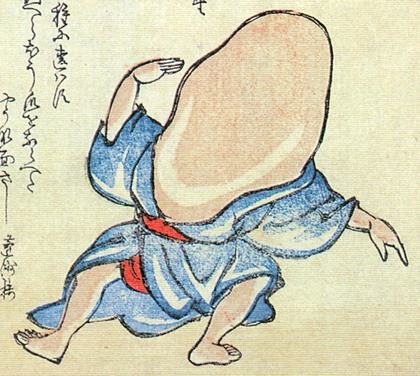
The woman slowly stood, turned her back and continued sobbing. The merchant lightly touched her shoulder and again pleaded with her to listen. She turned around, lowered her sleeve and passed a hand across her face. There were no eyes, nose or mouth. The man screamed and fled uphill. He made no attempt to seize her, strike her or discover whether she concealed a mask. Ahead lay darkness and emptiness. He continued running without daring to look behind him. Finally a tiny light appeared in the distance, resembling a firefly. After the disappearance of ordinary human features, even a solitary lantern promised a return to a comprehensible world.
Beside the noodle seller’s lantern
The light belonged to an itinerant soba seller who had placed his portable stall beside the road. The terrified traveller collapsed near him, hardly able to speak. The seller asked whether somebody had hurt him and then suggested robbers. The fugitive denied both explanations and struggled to say that a woman beside the moat had shown him something inexpressible. The vendor then passed a hand across his own face and asked whether it resembled what had frightened him. This second face became smooth like an egg, and simultaneously the light went out. Hearn stops there: no subsequent rescue of the merchant or explanation of the trick appears in the text.
Comparing the narrative and its title
The two appearances are connected by an identical gesture, but the story does not establish whether one being or several are responsible. Its title, Mujina, should not automatically become a claim that the protagonist identified a particular zoological species. A literature museum explicitly characterises such Hearn works as retellings of Japanese traditions; the author’s museum supplies biographical context. The real Tokyo slope establishes a setting, rather than the disappearance of faces. The relative reference to thirty years cannot supply a year for the encounter. Accordingly, the story receives neither an exact event date nor a coordinate presented as an observation site.


