A man behind the widow’s door
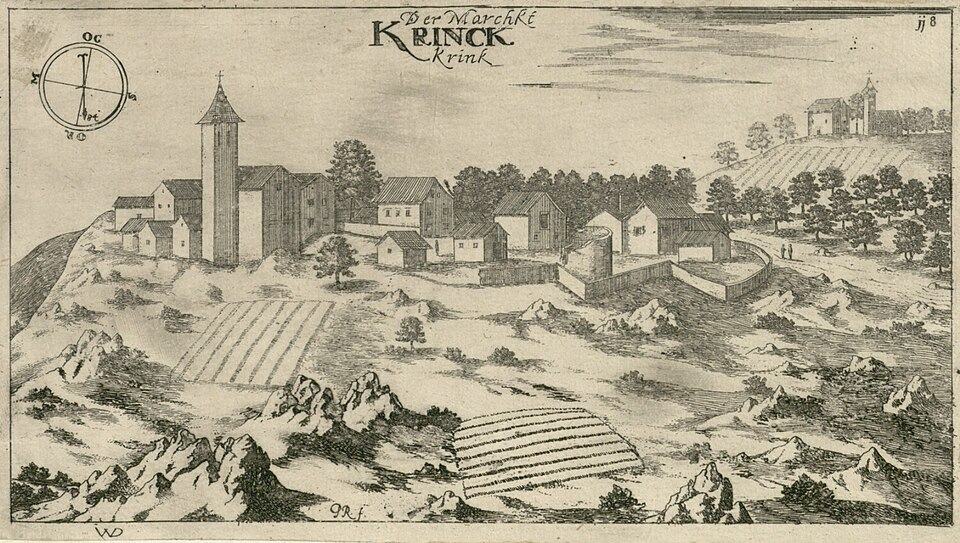
Johann Weichard Valvasor begins Kringa’s story with its conclusion: in 1672 villagers exhumed Georg, or Jure, Grando and cut off his head to secure peace. The author then returns sixteen years into the past. Grando had received Christian burial, yet Father Georgius, who performed the funeral service, allegedly saw him sitting behind the widow’s door. The priest fled in alarm. According to the same narrative, Grando subsequently appeared in the streets at night. His knocking on doors was understood as a warning that somebody in the house would soon die.
A complaint reaches the village head
The widow reported more than knocking. She alleged that her dead husband visited at night and forced sexual relations upon her. Valvasor describes her appeal to village head Miho Radetich, with whom she sought protection. The narrative connects communal fear of death with a woman’s private fear. Her own words do not survive independently of the book, however. A modern retelling cannot establish exactly what she experienced, still less accuse her of inventing it. What survives is a narrative in which the headman must end a calamity attributed to one deceased resident.
Nine living men against one dead man
The group went to the cemetery carrying two torches and a crucifix. The opened grave supposedly revealed a ruddy face that smiled and opened its mouth. The men scattered. Their headman shamed them: nine living men could not overcome a single dead one. Returning, they attempted to pierce the belly with a sharpened hawthorn stake, but the wood recoiled. Radetich held the crucifix before the corpse and addressed it as a štrigon. Valvasor even describes the headman mockingly as an inept exorcist, demonstrating that he evaluates participants rather than merely listing their actions.
An axe replaces the stake
Finally Micolo Nyena began cutting at the neck from a distance, afraid to approach. The more determined Stipan Milasich helped complete the task. According to the account, the corpse screamed, writhed and filled the grave with blood. After reburial, the widow and neighbours supposedly enjoyed peace. Valvasor states that he spoke with people present and regards the narrative as certain. This remains the author’s assertion about interviews, rather than a surviving examination report. The names make the story local and specific without establishing every physically extraordinary action described within it.
Comparing the štrigon and the vampire
Istrapedia stresses the original terminology: Grando is a štrigon, a local restless dead person, rather than a vampire defined by later literary conventions. Scholarship on Valvasor considers the episode within his encyclopaedic work, published in 1689. That date concerns the book, not the exhumation. Later retellings sometimes change the death date, participants or method of striking the corpse. The original permits the sixteen-year interval, failed staking and eventual decapitation to be distinguished. It securely preserves an early tradition about violence against a supposed revenant without establishing that Grando returned to life.


