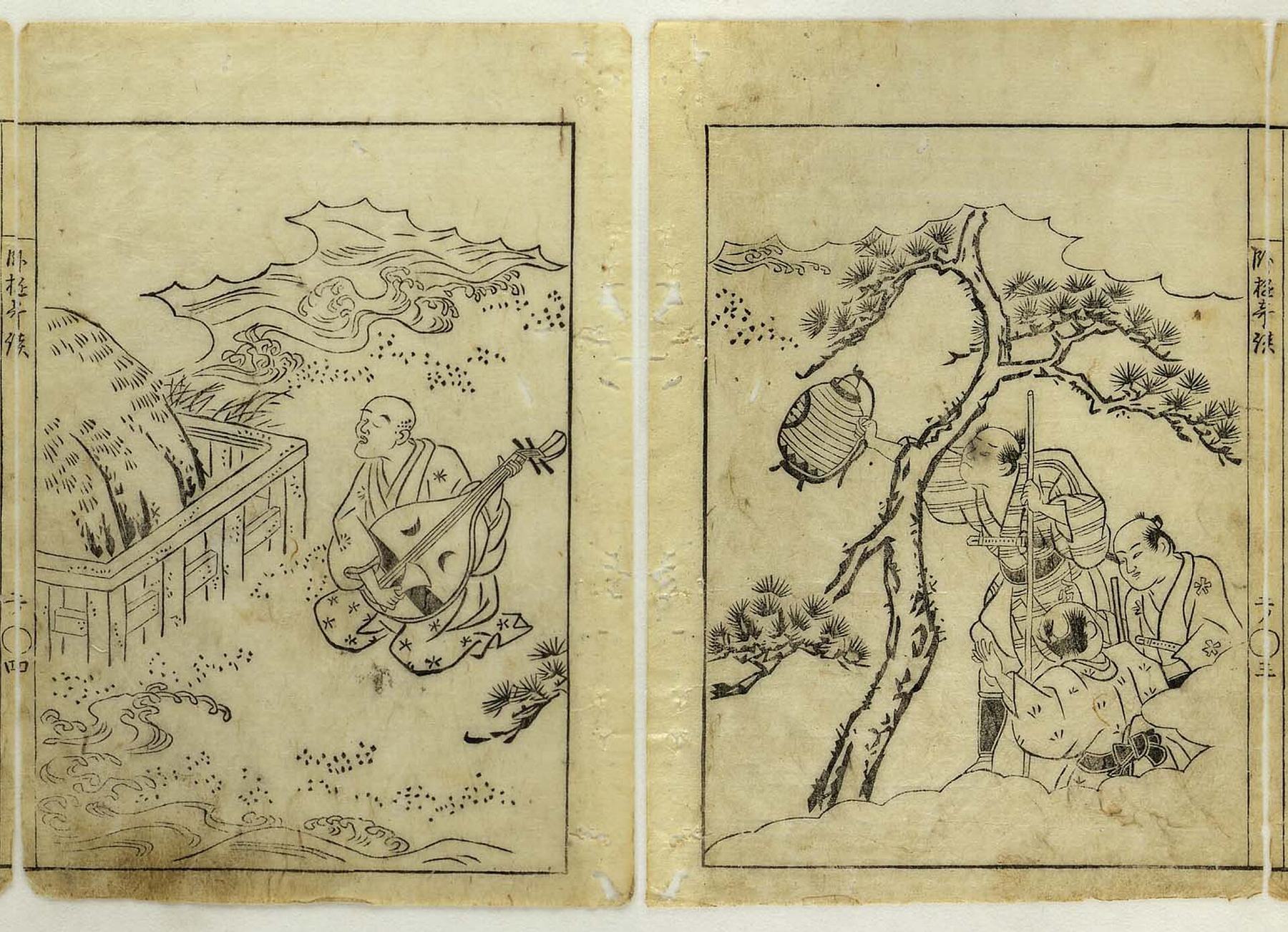
Music beside the sea of the dead
Lafcadio Hearn opens The Story of Mimi-nashi-Hoichi with the defeat of the Taira at Dan-no-ura. In his retelling, the waters near Shimonoseki retain the voices of the fallen, while the Amidaji temple helps pacify their spirits. Some unspecified centuries later, the blind musician Hoichi lives there. He plays the biwa with exceptional skill and recites the conflict between the Taira and Minamoto. A temple priest supports the impoverished performer, providing food and lodging in return for occasional performances. On a summer night, while the priest attends a service for a dead parishioner, Hoichi sits alone on the veranda and hears an unfamiliar, commanding voice.
An invitation difficult to refuse
A warrior orders him to visit his lord: distinguished guests wish to hear the story of the final battle. Hoichi takes his instrument and accepts guidance. He hears the heavy steps of an armed escort, gates opening, sliding partitions moving and the rustling of costly clothing. Women’s voices convince him that he has entered a large aristocratic household. The audience requests the Dan-no-ura episode in particular. As he recites the death of the young emperor and his companions, sobbing surrounds him. Afterwards he is asked to return for several nights and to tell nobody about this private gathering of important visitors travelling without public announcement.
Where the performer is actually discovered
The temple priest notices Hoichi’s nocturnal absences and becomes concerned about his condition. Servants are sent to follow him. Instead of finding a grand house, they discover the musician in a cemetery, performing before Emperor Antoku’s memorial and surrounded by wandering lights. Hoichi resents their interruption because he still experiences himself as the participant in a courtly entertainment. The priest explains that the dead have summoned him and that further visits threaten his life. The narrative’s crucial distinction is between the palace the blind artist understands through sound and the cemetery seen by the people who come to bring him back.
Protection and the forgotten ears
To conceal Hoichi from the returning messenger, his body is covered with a sacred text. He must remain perfectly still and refuse to answer any call. The assistant, however, neglects to inscribe his ears, and the senior priest fails to check that part of the work. The warrior returns and cannot see Hoichi himself, but notices two ears. Deciding that they are all that remains of the invited performer, he tears them off as evidence to take to his lord. Hoichi endures the ordeal without speaking and survives. In the morning the priest discovers the consequences, obtains medical help and cares for him. Fame subsequently attracts wealthy listeners, although his nickname permanently preserves the injury.
Comparing the legend and its historical setting
Hearn’s narrative permits the prohibition on speech, cemetery discovery and omission of protective writing to be checked precisely. Museum materials describe such works as literary retellings of older Japanese stories. Information about the author and subsequent exhibitions does not constitute additional testimony to Hoichi’s injury. The battle and commemorative traditions provide a recognisable setting, but their historical reality does not verify a ghostly audience. The battle’s year is therefore not assigned to the musician’s encounter, and the location of a historical temple is not presented as a coordinate for an independently established supernatural event.


