Two spacecraft measured the Moon through their motion
Gravity Recovery and Interior Laboratory consisted of two small spacecraft known as Ebb and Flow. They launched in September 2011, and both had entered lunar orbit by early 2012. Their task depended on flying as a pair: changes in separation and relative velocity helped reconstruct variations in the gravitational field. Motion above the surface thereby provided information about an interior that could not be directly photographed. These measurements were the main scientific mission. The final impacts came afterwards, as operations approached their end and little fuel remained for continued controlled flight. The impact story should not obscure the mapping work that preceded it.
An ending planned in advance
On 17 December 2012 the spacecraft were directed into a mountain massif at northern lunar latitudes. This was not the unexpected disappearance of two unknown objects. NASA described the controlled end of the flight beforehand and subsequently reported completion of the manoeuvre. Ebb and Flow reached the surface about half a minute apart. Mission announcements gave an impact speed of roughly 1.7 kilometres per second. This created an unusually useful starting point for studying a collision: the origin, construction materials and circumstances of the impacting bodies were substantially better known than those of a small natural meteoroid arriving without advance warning.
An orbital camera found the aftermath
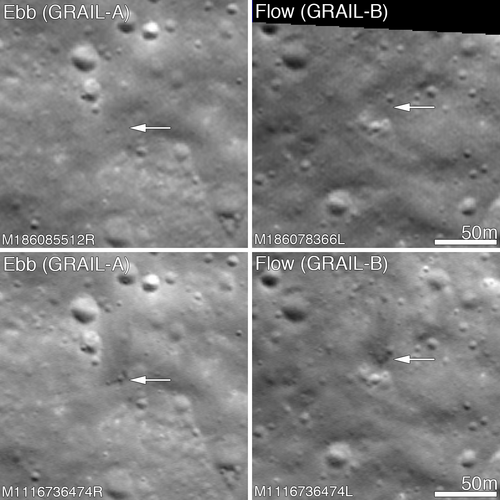
Lunar Reconnaissance Orbiter images revealed craters about five metres across. Both impacts occurred on the massif’s slope but produced separate features. Images and subsequent topographic processing allowed the traces to be compared with the recorded end of the mission. Dark, unevenly distributed ejecta attracted particular attention. Fresh material excavated from beneath a surface altered by the space environment is often brighter than the surrounding soil. In these cases the simple expectation did not hold. Small, anticipated collisions acquired their own scientific puzzle, concerning the appearance of the resulting material rather than the identity or intentions of the spacecraft.
Dark ejecta and Sally Ride’s name
The image description considered carbon-bearing spacecraft materials, including composites and remaining fuel, as a possible explanation. Mixing such material into the ejecta could alter its reflectance. The authors presented a possibility while retaining uncertainty about the cause of the dark rays. We likewise do not turn the suggestion into a completed chemical analysis of every patch. NASA named the impact area for Sally Ride, the first American woman in space and a member of the GRAIL team. The name connects the research mission, its educational work and the memory of a participant; it does not identify a separate naturally occurring lunar anomaly.
Comparing a trajectory, an image and a marker
The mission archive explains the spacecraft’s purpose, the end-of-flight announcement records the event, and LRO materials show the resulting craters. NASA’s artificial-object catalogue lists the two locations separately. Our globe marks the catalogued GRAIL A position at 75.6088 degrees north and 26.5940 degrees west. The other crater should not be treated as the same point. Differences between an early predicted location and a later cartographic measurement do not mean an impact moved: the accuracy of its registration changed. Securely established human origins for both craters can coexist with an unresolved question about the detailed composition responsible for unusually dark ejecta.


