A known body and an unseen life
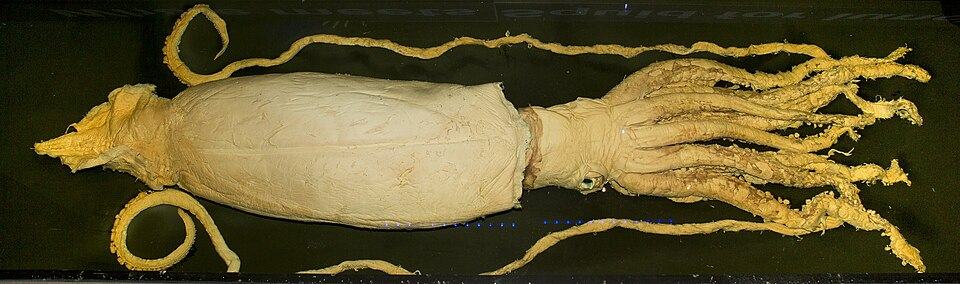
By the beginning of the twenty-first century the giant squid did not depend on sailors' stories for its existence. Museums held bodies and body parts, and further specimens appeared on beaches and in fishing nets. Watching a living adult in its ordinary deep-water environment, however, had proved extremely difficult. That gap encouraged imagination: enormous tentacles were a physical fact, while the behaviour of the unseen animal was reconstructed from fragments of information. The famous 2004 photographs matter as an observational achievement. They were not the first evidence that large squid inhabited the modern ocean.
Following clues from sperm whales
Tsunemi Kubodera and Kyoichi Mori worked off Japan's Ogasawara Islands. In choosing depths they used information about the dives of sperm whales, which feed on squid. Instead of pursuing an animal continuously with a submarine, they deployed a suspended system with bait and a camera looking down towards it. Instruments also recorded depth and conditions. Interval photography allowed the equipment to wait for an animal without a human observer immediately beside it. This did not eliminate experimental influence: the food deliberately attracted a predator, and the encounter occurred around an artificial apparatus. It nevertheless offered a rare opportunity to document a sequence of actions in deep water.
The morning of 30 September
On 30 September 2004 a squid attacked the bait at approximately 900 metres depth. Photographs showed spreading arms and long feeding tentacles; one tentacle became caught on the apparatus. The sequence continued over several hours as the animal attempted to escape. Eventually the tentacle broke, and the squid disappeared from view. Researchers recovered the remaining fragment on deck. Their paper provides the image sequence and the station coordinates. The observation was consequently linked to a place, date and physical material, rather than resting only on a person's account of briefly seeing something large below the surface.
What the sequence revealed
The results were published in 2005. The authors considered the active attack important because it challenged a simple picture of the squid waiting passively for prey with its arms hanging down. The recovered tentacle supplemented the photographs and allowed visible features to be compared with anatomy. Later video records belong to separate episodes and should not be folded into the date of this first photographic encounter. Behaviour around bait, particularly after becoming hooked, also cannot describe an animal's entire undisturbed life. Estimates of size require similar care: the length of a long feeding tentacle is not the same measurement as the length of the body.
The kraken and a testable result
The research paper and museum accounts agree on the principal achievement: photographs documented a living giant squid in its natural habitat in 2004. The apparatus explains both the strength and the limitations of that evidence. It provides firmer information about predatory activity, without validating stories of attacks on large ships or identifying every unfamiliar marine silhouette. The case sits beside cryptid histories because of the animal's long cultural association with the kraken. Architeuthis itself is presented here as a real animal under investigation. What was extraordinary was obtaining the observation, rather than discovering a supernatural sea monster.


