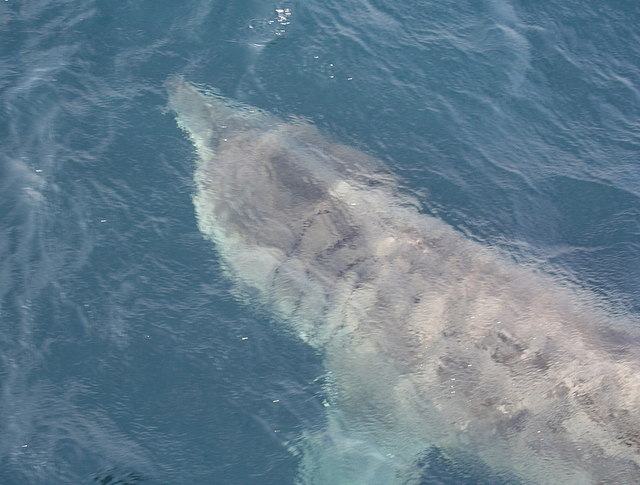
An unusual catch off New Zealand
On 25 April 1977 the Japanese trawler Zuiyo Maru brought up the decomposed carcass of a large marine animal while operating off New Zealand. Remains of a head, an elongated front section and flipperlike appendages resembled the familiar image of a plesiosaur in photographs. The discovery looked sensational partly because soft tissues were missing: viewers were reconstructing a living animal from incomplete remains. Fishing-company representative Michihiko Yano recorded photographs and measurements. The crew discarded the complete carcass rather than preserving it. Subsequent investigation therefore depended on limited documentation and retained fibers instead of an accessible museum skeleton.
How a long neck can appear
Plesiosaurs were marine reptiles with four flippers, and many possessed genuinely long necks. A similar outline can emerge during basking-shark decomposition when jaws and gill structures disappear. London’s Natural History Museum discusses misidentified marine remains as a recurring source of supposed living-plesiosaur evidence. This concerns comparative anatomy of decomposition, rather than an assumption that every unidentified carcass must be a shark. For the Zuiyo Maru material, photographs need to be considered alongside surviving tissues and the order in which different structures could disappear, rather than judged solely against a recognizable prehistoric-animal silhouette.
A collection of studies replaces a headline
In 1978 the Societe franco-japonaise d’oceanographie published a collection of investigations edited by Tadayoshi Sasaki. Japan’s CiNii database confirms the volume’s existence and publication details. A university-hosted bibliography separately lists Shigeru Kimura and colleagues’ paper on the morphology and chemical composition of the horny fibers. The investigation consequently involved more than opinions about a photograph: contributors considered comparative anatomy, retained material and biochemistry. The original complete collection is not represented here as newly inspected laboratory documentation. Specific analytical findings are attributed through a review that identifies the original work and pages, distinguishing a primary study from its later interpretation.
The retained fibers provide a test
Glen Kuban’s review describes comparison with elastoidin from basking-shark fins. Kimura and colleagues compared amino-acid composition and microscopic structure, obtaining particularly close matches when comparison material underwent the same hypochlorite treatment. The original investigators regarded the results as strong evidence for a basking shark or a related species. This was a biochemical argument rather than DNA sequencing, and did not involve tissue from a living plesiosaur. Earlier work by Kimura and Kubota on elastoidin shows that the material’s properties were being investigated before the famous catch. The tissue comparison existed independently of the publicity-friendly description of a new Nessie.
Comparing evidence and limitations
Photographs document the outline of the decomposed remains, while retained fibers permit a narrower biological test. Combined with known patterns of shark decomposition, they make the shark interpretation substantially stronger than a surviving marine reptile. Losing the complete carcass limits precision and prevents a new full examination. It does not make a plesiosaur equally probable alongside positive similarities to shark tissue. The explained classification here means the best-supported identification from the surviving material. An initially unidentified animal genuinely prompted investigation, but the cited sources do not establish a new species or a plesiosaur surviving the extinction of its lineage.


