15 August 1977: what the map marker means
Big Ear in Ohio was searching for narrowband signals when it registered an unusual increase in intensity. The familiar date, 15 August, uses local time; in UTC it was already 16 August. Our globe marker identifies the receiving instrument’s general location. It does not mean that the signal originated above Ohio, and it cannot place a hypothetical civilisation on an Earth map. The distinction between a detection site and an emission source is essential to reading this case correctly.
Six characters are not the text of a message
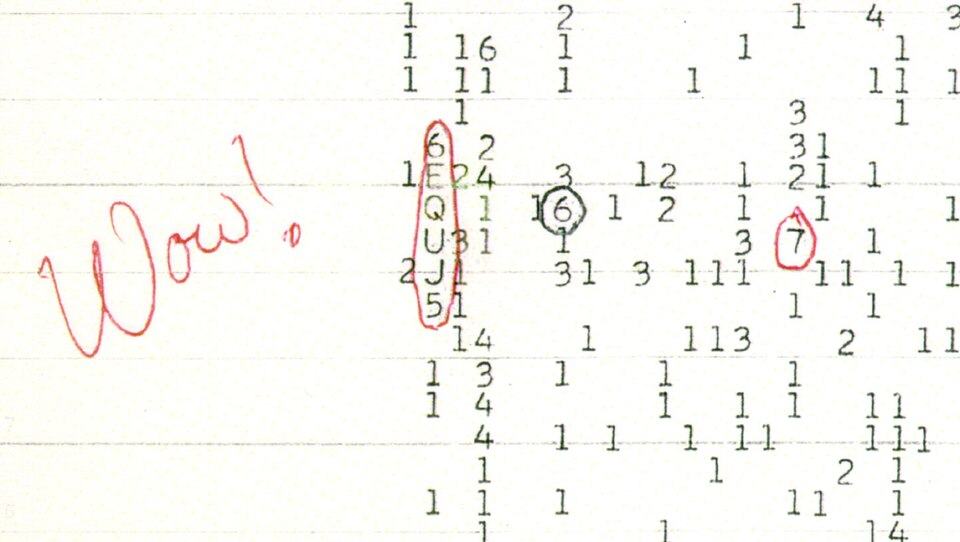
Jerry Ehman noticed 6EQUJ5 on the computer printout and highlighted it with “Wow!” The characters encode changes in measured intensity, rather than a decoded sentence. The six samples cover roughly 72 seconds, associated with a direction passing through the fixed instrument’s beam. This record cannot automatically establish the source’s full emission duration. An instrument reports what enters its observing window; that need not mark the beginning and end of the underlying physical process. Reading the printout as a message skips this crucial distinction.
Why one detection cannot identify the source
Ehman’s documentation stresses limitations of the original observation, including uncertainty about which of two feed horns received the signal. Even the direction therefore had alternative reconstructions. Failure to repeat the detection does not demonstrate deliberate silence by a sender: a source could have been transient, variable or unrelated to technology. A new hypothesis must explain the combination of measured characteristics, rather than select narrow bandwidth alone. The distinction between measurement and interpretation remains necessary even for a remarkably unusual record.
Follow-up searches test particular scenarios
Breakthrough Listen published results from observations of a proposed direction in 2022 using the Green Bank Telescope and Allen Telescope Array. Such work tests particular frequencies, times and sensitivities, rather than every imaginable emission over decades. A separate study of a stochastic repeating beacon examined which repetition rates remain compatible with earlier searches. Its models illustrate limits on conclusions drawn from missed detections; they do not discover an existing beacon or identify a sender. A negative search must be read with its observing coverage.
What the 2025 archival analysis changed
The authors of Arecibo Wow! II re-examined archival Ohio SETI material and proposed revisions to the signal’s position, intensity and frequency. They discuss an astrophysical explanation involving cold neutral-hydrogen clouds and compare the event with other narrowband detections. This is a useful research direction, but a mechanism hypothesis is not a repeat detection of the original event. The update also demonstrates why older precise numbers should identify their analysis version and the receiver configuration on which they depend.
What would genuinely change the assessment
A repeat observation recorded simultaneously by independent instruments, with data preserved for inspection, would be especially valuable. It could connect direction, spectrum and timing with tests of local interference and astrophysical models. For now, the unusual recorded event, particular explanations and the cultural image of a “message from space” should remain distinct. The signal is interesting as a constrained question about evidence: uncertainty calls for stronger tests, rather than serving as ready-made proof of whichever explanation is preferred.


