The event of 30 June
On the morning of 30 June 1908, a fiery object appeared over a remote part of Siberia, followed by a flash and a powerful explosion. That is the event’s Gregorian-calendar date; Russia’s contemporary Julian calendar recorded 17 June. Witnesses described heat, thunderous noise and damage to dwellings. The modern reconstruction, however, rests on more than striking testimony: its central physical evidence is a vast area of fallen forest near the Podkamennaya Tunguska River. The absence of a nearby city reduced human exposure without reducing the event’s physical scale.
Why the investigation arrived late
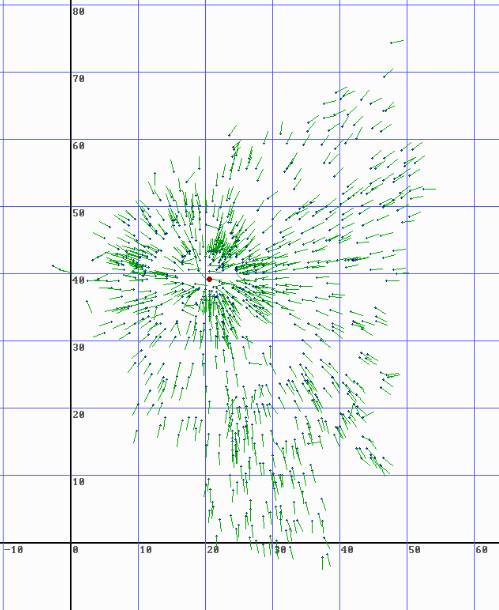
Leonid Kulik attempted to reach the region in 1921 and finally reached the destruction site in 1927, nineteen years after the explosion. NASA’s historical account connects the delay with remoteness, war and political upheaval. The forest still preserved evidence: trunks lay around the central area, while nearer the centre some trees remained upright with broken branches. Subsequent ground and aerial surveys identified a characteristic butterfly-shaped damage zone covering roughly two thousand square kilometres. This is substantially firmer evidence than trying to reconstruct the entire event from one recollection recorded years later.
An airburst explains the missing crater
The principal scientific explanation is that a cosmic body broke apart in the atmosphere. At high speed, interaction with the air rapidly transfers kinetic energy into heating and a shock wave. NASA Earth Observatory discusses an explosion altitude of roughly 6–10 kilometres. In this scenario, flattening the forest does not require an intact asteroid to strike the soil. Upright but stripped trunks near the centre are also consistent with force arriving from above. The absence of an accepted crater therefore constrains the search for remnants, without independently disproving an airburst.
What determines the proposed object’s size
Tunguska left no video, modern satellite measurements or specimen securely linked to the explosion. Its dimensions must be inferred from the effects and models of atmospheric disruption. Different sources give different ranges: Earth Observatory uses 50–100 metres, while a probabilistic study in NASA’s archive discusses prevailing estimates of 50–80 metres and 10–20 megatonnes of energy. Those numbers should not be merged into one exact specification. Density, strength, speed and entry angle all influence which incoming body could produce the observed pattern of forest damage.
Asteroid, comet and Lake Cheko
Both asteroid and comet interpretations have been discussed historically. NASA notes that most researchers now favour an asteroid, but this is not equivalent to a laboratory determination of the composition of a recovered rock. A separate dispute concerns Lake Cheko: some researchers proposed that a fragment created its basin, while others contest that connection. The Earth Observatory account explicitly preserves this disagreement. Establishing or rejecting one proposed crater does not automatically answer every question about the main atmospheric explosion.
Why new models do not replace old evidence
In 2019, researchers revisited the event through computer calculations and comparison with the well-recorded Chelyabinsk fireball. They examined which incoming objects could reproduce Tunguska’s effects and how often similar damage might occur. Modelling tests the compatibility of scenarios with observations; it cannot supply the missing recording from 1908. Our editorial assessment therefore separates levels of confidence: a cosmic atmospheric event explains the collected evidence more convincingly than exotic alternatives, while the object’s precise physical parameters remain a legitimate research question.


