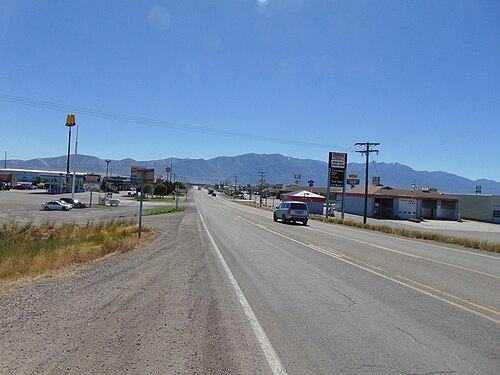
A stop beside the highway
On the morning of July 2, 1952 Delbert Newhouse was driving through northern Utah with his wife and two children. About seven miles north of Tremonton, his wife drew his attention to an unfamiliar group in the sky. He stopped the car, retrieved a movie camera from the luggage and began filming. His account described ten or twelve bright objects moving in an irregular group, generally westward. Unlike many verbal UFO reports, this brief roadside stop left material that other people could inspect independently, one frame at a time.
The camera recorded less than the observer
Newhouse used a handheld 16-millimeter Bell and Howell camera with a telephoto lens and Kodachrome color film. The recording shows bright points without securely resolved structural details. He reported that one point separated and moved in the opposite direction, after which he followed it with the camera. In his early letter he specifically acknowledged the absence of reference points for estimating size, altitude, distance or speed. This limitation belongs to the original testimony itself: precise flight parameters introduced later cannot be attributed to measurements made by Newhouse.
Military specialists received the footage
The material entered the military system for investigating UFO reports. A Navy photographic laboratory studied motion and brightness changes, and its results were presented to the Robertson scientific panel in January 1953. The panel had the film, the sighting history and previous interpretations. A CIA overview describes approximately 1,600 frames as valuable documentary material. Yet many sequential frames from a single camera do not automatically provide a second viewpoint. Object distance remains unknown unless it can be established through geometry or a known physical size.
Why the brightness analysis was disputed
The panel criticized motion inferences based on changes in luminosity. Its report noted that some photometric work used a duplicate whose background and contrast differed from the original; calibration of the film's sensitivity was also missing. A solar reflection changing orientation can brighten or disappear without fantastic acceleration. Brightness therefore did not become a reliable distance measurement. Panel members favored birds illuminated by sunlight. They also discussed comparison experiments with balloons, intended to test how known objects would appear under similar conditions.
A later investigation returned to the setting
The University of Colorado study revisited the episode. William Hartmann compared testimony, camera characteristics and the visibility of birds near Tremonton. His conclusion distinguished the entire visual account from the film itself: the images were consistent with birds and did not establish extraordinary aircraft. That is different from identifying every frame down to a bird species. Meanwhile the film's administrative history survived: a National Archives inventory lists the Tremonton color reel separately from other famous recordings. Preservation of a cataloged object and correctness of its interpretation remain separate questions.
Comparing the explanations and conclusion
Newhouse supplied a sincere account and useful recording; a laboratory offered analysis, and subsequent specialists identified limitations and a terrestrial alternative. The ability to return to the images is the case's strength; missing scale and independent range are its weakness. Birds can explain changing brightness and group movement without introducing new physical laws. The material does not prove extraterrestrial origin or substantiate incredible velocities later assigned to it. This entry therefore preserves the history of disagreement, recognizing a genuine observational document while treating interpretation as a problem constrained by limited data.


