Landing instead of colliding
Surveyor 1 left Earth on an Atlas-Centaur rocket on May 30, 1966. Unlike the Ranger spacecraft, designed to transmit pictures before impact, it had to decelerate and remain operational on the ground. NASA's Jet Propulsion Laboratory managed the project and Hughes built the spacecraft. It was the first successful American lunar soft landing, rather than humanity's first: the Soviet Luna 9 had already reached the surface in February. Preserving that distinction maintains the real chronology without diminishing the difficulty of Surveyor's independent engineering achievement.
Braking above the Ocean of Storms
After roughly sixty-three and a half hours in flight, the spacecraft approached the Moon. A main braking motor and controlled smaller engines reduced its speed using radar measurements of height and motion. On June 2 Universal Time it landed in Oceanus Procellarum near Flamsteed P. American reports sometimes say June 1 because they use local time. NASA's historical account describes a small bounce before it settled. The landing tested the entire chain of navigation, sensing, braking, footpad structure and equipment survival during direct contact with unfamiliar ground.
The surroundings appear on a screen
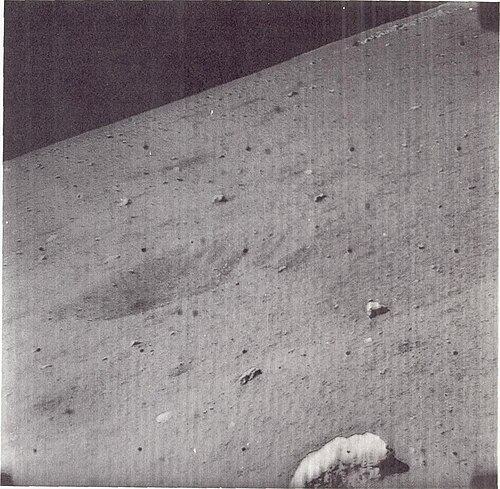
Engineering information first reported the spacecraft's condition to Earth. The camera then showed structural details, a footpad and the dark surface. This was a different view from Ranger's rapidly enlarging approach images: investigators could revisit neighboring patches, redirect imaging and inspect the mark of contact. A footpad supplied a useful scale reference. Shadows and nearby stones helped describe the terrain. One spacecraft nevertheless viewed a limited locality, so its surroundings cannot become an exhaustive model of the entire lunar surface or establish the safety of unrelated landing areas.
The ground holds, with questions remaining
Surveyor 1 showed that its footpads at this location did not disappear into a deep layer of loose dust and that the spacecraft could operate stably. Images and engineering measurements supplied evidence about ground behavior under load. Colored filters allowed the camera system to assemble color views, while successive imaging expanded the panorama. A supportive landing patch did not imply an absence of fine dust or hazardous slopes elsewhere. Apollo planning still needed to combine surface experience with orbital mapping and other landings in geologically different areas.
Night and an unexpected continuation
At the end of the first lunar day, sunlight stopped supplying power through the solar panel. Engineers did not know whether the station would survive the long cold interval. After silence it responded again and returned additional pictures. NASA's historical overview gives a final total of 11,240 frames, while the University of Arizona preserves material for further study. Early summaries sometimes contained interim image totals and subsequently revised coordinates. A contemporary progress report, a final history and a modern catalog can therefore differ numerically without undermining the landing or the existence of the photographs.
Comparing the mission evidence
Contemporary JPL reports show what was known shortly after operations, NASA's history reconstructs the overall result, and the photographic archive leads back to observational material. All three support a successful soft landing and extended imaging. Historical position requires sensible rounding, while the date requires a stated time system. The scientific value lies in testing a real lunar locality with equipment of known mass and construction. That local, measurable knowledge proved more useful than broad speculation about whether anything could stand on lunar ground, although further sites still required their own investigation.


