A rare opportunity to test a prediction
Investigations of historical bright flashes usually begin after the event. The story of 2008 TC3 is different: the object was observed in space, its approach calculated and the prediction compared with atmospheric entry. The Sudan case is particularly useful for understanding scientific testing. An explanation was not merely fitted retrospectively to an unusual impression: it specified in advance where and when an event should occur.
From discovery to atmospheric entry
Richard Kowalski discovered the small asteroid through the Catalina Sky Survey on 6 October 2008. Observations quickly reached the Minor Planet Center, and calculations indicated an imminent collision with Earth. Follow-up measurements from different observatories refined the orbit. This was distributed work: trajectory reliability depended on a sequence of object positions rather than one especially persuasive photograph.
Early on 7 October the body entered the atmosphere over northern Sudan and fragmented. JPL's account compared predictions with incoming observations. Initially, the main test concerned agreement in entry time and location. Locating a fireball confidently did not guarantee that large fragments would be recovered: material might have disintegrated and dispersed. The next part of the story therefore required a separate field investigation.
Searching the ground
Muawia Shaddad of the University of Khartoum and Peter Jenniskens helped organise a search in the Nubian Desert. Teams traversed the predicted fall region and recovered meteorites collectively named Almahata Sitta. The first Nature paper described 47 fragments. This represents one stage of recovery, not a timeless final total of every specimen found subsequently.
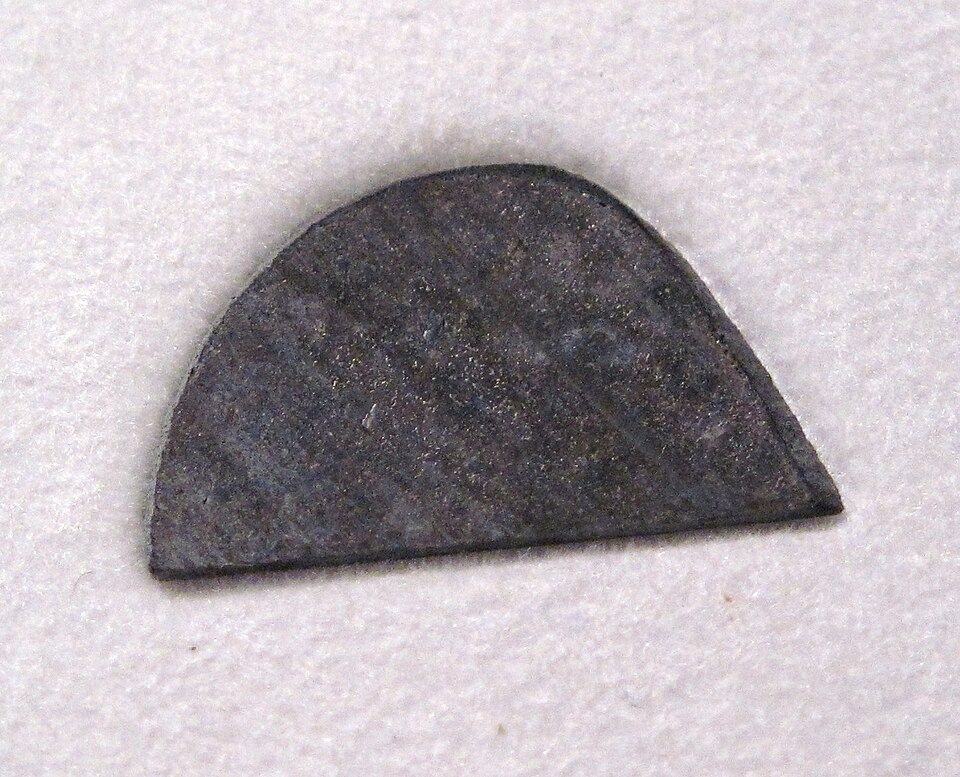
Researchers could compare the material's properties with pre-entry asteroid observations. The comparison links three very different scales: a distant point of light, an atmospheric flash and a small laboratory stone. Each transition nevertheless requires evidence. Finding a dark rock in a desert is not sufficient: location, material properties and agreement with the expected strewn field matter. The combination makes the connection persuasive.
What this success does not promise
The event is sometimes retold as evidence that hazardous bodies are always detected beforehand. That conclusion goes too far. Detectability depends on size, brightness, approach direction and sky coverage. One successful prediction tests one orbit and the network's performance in that case; it does not automatically measure complete planetary protection or guarantee a warning interval for a future event.
The map marks an approximate Sudanese region, rather than an individual museum stone. Reading the sources benefits from separating discovery date, atmospheric-entry date and expedition dates. They form an evidential chain but are different stages of investigating one body. The unusual feature is the quality of that connection. A testable prediction and laboratory specimens provide substantially more information than a later account of bright light lacking time and location.


