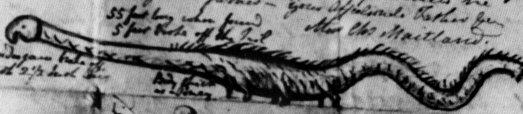
A carcass on an Orkney shore
In September 1808 the remains of a large marine animal were found on Stronsay. The sea had already altered the body. Observers therefore described a difficult product of decomposition rather than an intact living creature. A long central axis, a relatively small head and projecting structures suggested a sea serpent. Accounts gave a length of about fifty-five feet. That impressive measurement later became a major argument against an ordinary zoological identification, although the object being measured was a damaged carcass rather than a complete fish.
The island witnesses did more than repeat a story. Their descriptions were collected and formalized, and portions of the animal reached naturalists. These surviving connections distinguish the incident from a distant glimpse offshore. There was material to inspect, but its condition made interpretation unusually dependent on testimony.
Letters and scientific authority
The Royal Society archive preserves a letter from Gilbert Meason to Joseph Banks, eyewitness declarations and a drawing. Dated November and December of that year, these documents associate the discovery with Rothiesholm on Stronsay. They reveal how information travelled from a shoreline community to people influencing accepted natural knowledge. The drawing formed part of an argument about anatomy, rather than a photograph preserving every feature without mediation.
Edinburgh anatomist John Barclay regarded the evidence as substantial support for a great sea snake. Agreement and standing of witnesses mattered to his reasoning. Historian Bill Jenkins shows that the dispute also concerned who could contribute authoritative observations. Describing it simply as credulous islanders corrected by scientists would miss the contemporary debate about observation, testimony and classification.
How a shark acquires a neck
Other anatomists compared the remains with sharks. In a decomposing basking shark, the loss of soft tissues around the broad head and gill apparatus exposes structures that look very different from the living animal. Damage to the tail and surviving projecting fin supports can reinforce the unfamiliar outline. An apparent neck can be exposed vertebral material formerly enclosed by a much wider front portion.
Later anatomical discussion, including John Goodsir's treatment, strengthened the shark interpretation. The reported exceptional length nevertheless kept alternatives alive. Assessing that number requires knowing where measurement began, what portions were connected and whether the damaged body retained its original proportions. Confidence in witnesses does not independently establish those anatomical details.
Comparing the explanations
The case belongs beside other stranded marine carcasses whose loss of flesh produces an apparently reptilian outline. It contains a genuine discovery, an archival trail and an anatomical explanation, but no complete specimen available for renewed examination. A decomposed shark is the best supported interpretation, with those limitations stated explicitly. An honest description of an extraordinary appearance can still result in an incorrect identification of the animal responsible.


