An evening report outside town
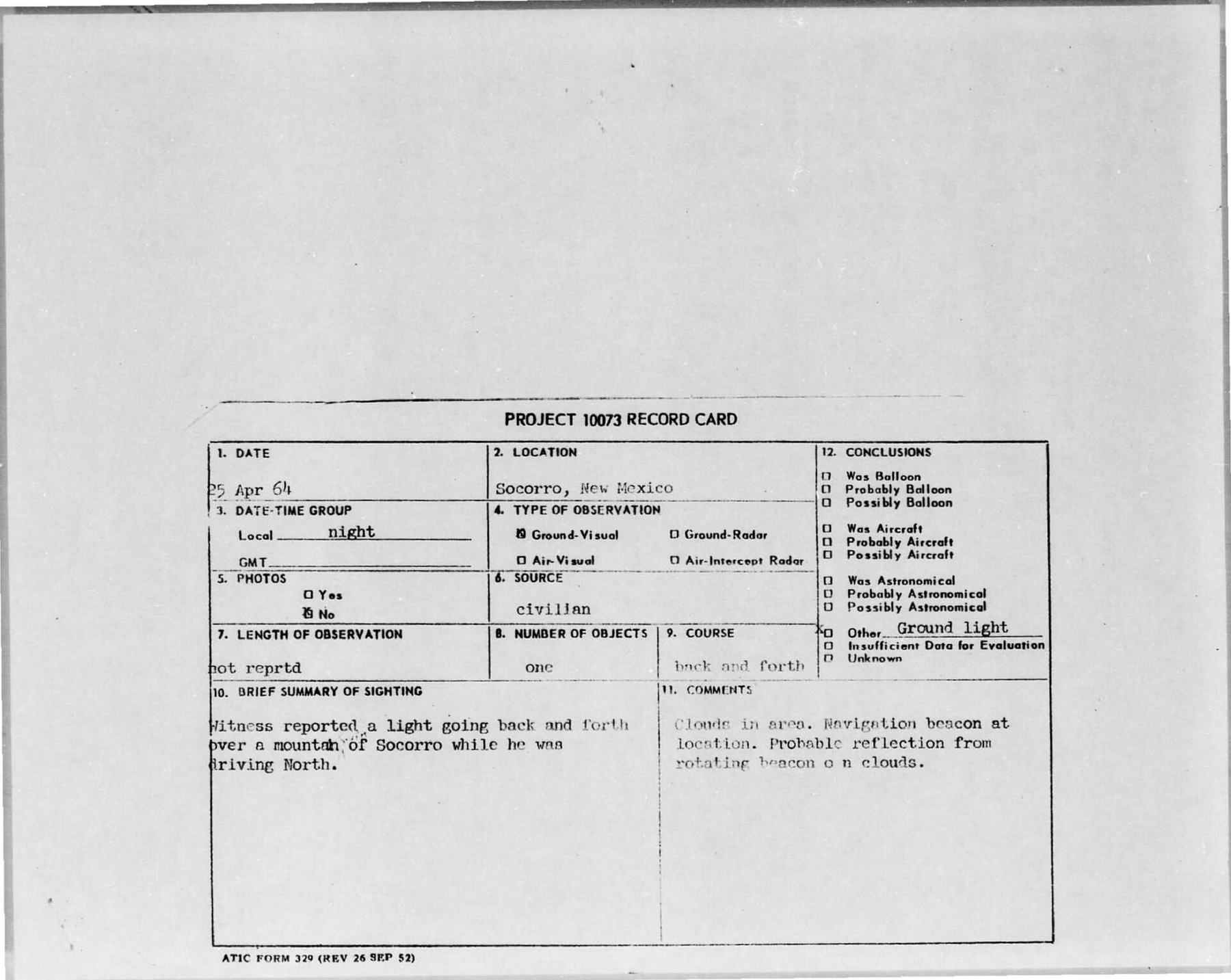
On 24 April 1964 police officer Lonnie Zamora reported an incident near Socorro, New Mexico. In the early account he heard a loud sound, noticed a flame and went to investigate a possible explosion. He then said he saw a light-coloured object that initially resembled a car, with two figures nearby. The alleged landing became the subject of FBI and Project Blue Book records.
The coordinates in this entry identify the general outskirts of the town, rather than a measured craft position. The year filter uses the encounter report's date, 1964, rather than the later release date of the documents.
Why the early record matters
An FBI communication prepared shortly afterwards records Zamora's account and the subsequent site inspection. It allows the initial version to be compared with later retellings. Nevertheless, it remains a record of information received: the writer of the communication did not observe the alleged departure.
Comments about the officer's reputation help explain why investigators took the report seriously. They do not replace measurements of shape, distance or speed. An honest, experienced witness can still misidentify an unfamiliar object during an unexpected event.
Traces and the limits of causation
Officers arriving after the call noted depressions and burned vegetation. Two propositions need to remain separate: traces were observed at the site, and an unknown vehicle caused them. The second does not follow automatically from the first. Establishing it would require connecting the traces' formation time, the site's earlier condition and independent indications of the proposed mechanism.
The archive file is best read as a sequence: who collected material, when it was examined and what control comparisons were available. A large page count does not, by itself, demonstrate a hypothesis about the traces' cause.
What the Blue Book director reported
Hector Quintanilla discussed Socorro in an article on investigative methods published in Studies in Intelligence. His account says the checks found no foreign material in the soil, unusual radiation or chemical propellant residues on the vegetation. Investigators did not identify the stimulus that had frightened Zamora.
An important equipment qualification also appears: the nearest specified radar had stopped operating for the day. The absence of a corresponding return therefore cannot become either a universal disproof of the account or proof that a vehicle could evade radar.
Why “not identified” remains a distinct outcome
A later CIA explanatory article retains Socorro as an example of an unresolved case and discusses its methodological lessons. That is not a confirmation of extraterrestrial origin. The investigative author likewise did not regard the available results as evidence of such an origin or a security threat.
Revising the assessment would require new testable information: original material with a clear provenance, an independent observation, or a reproducible model explaining the complete sequence. A confident later description of details is not a new measurement. Preserving the documented core and marking its limits is more useful than filling the gaps with a familiar spacecraft image.


