A flash closer than most of its relatives
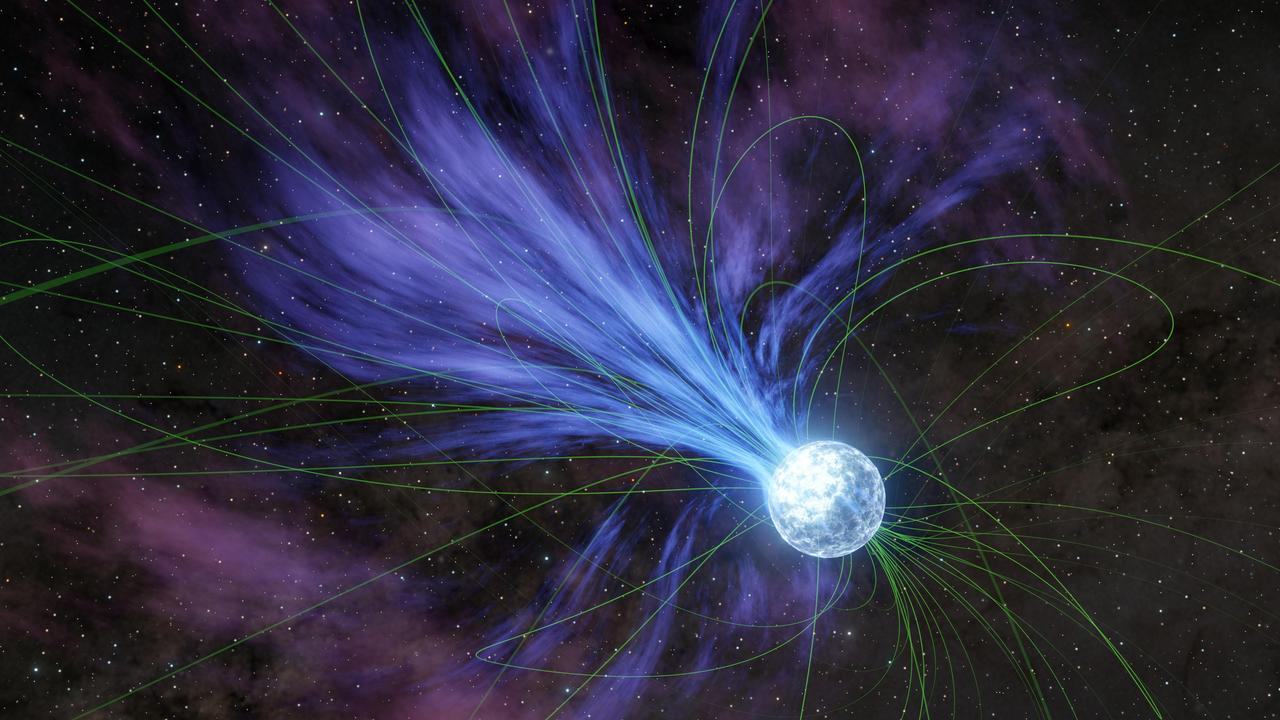
Fast radio bursts attracted attention through their extremely short durations and striking apparent brightness. Most known sources lay outside the Milky Way, making it difficult to identify an object from an isolated radio recording. In spring 2020 a known Galactic magnetar, SGR 1935+2154, became active. A magnetar is a neutron star with an exceptionally strong magnetic field. During late April it emitted a series of high-energy bursts. Against that background, an episode on 28 April offered a connection between a radio flash and an object already accessible to observations in other wavebands. Researchers could test the proposed origin using several independent records rather than relying on the appearance of one radio trace.
Two radio systems recorded the episode
The Canadian CHIME instrument and the STARE2 system detected a bright radio burst at different frequencies. STARE2 was designed partly to catch exceptionally bright Galactic events; its stations, relatively simple compared with giant radio telescopes, made an important contribution. The team’s study describes a signal lasting milliseconds. Lower- and higher-frequency records need not look identical: propagation through the interstellar medium changes the arrival time of different radio frequencies. Comparison must account for this effect. What matters after that correction is agreement in the direction and timing of the event, rather than a merely visual resemblance between lines on two plots or an imagined sound heard directly from space.
X-ray observations supplied another connection
High-energy observations recorded an associated burst. Participating instruments included Europe’s INTEGRAL, China’s Huiyan and the Russian Konus instrument aboard Wind. Different detection methods allowed researchers to examine a spatial and temporal coincidence that a single radio receiver could not establish alone. NASA and ESA accounts explain why the combination of wavebands was central to the result. The story is therefore more specific than a particularly loud cosmic noise: a known object was active, independent instruments recorded a related episode, and investigators could compare physical measurements. The observation concerns electromagnetic radiation measured by instruments, not an audible message or a voice arriving from the magnetar.
What changed in the explanation of radio bursts
The observations demonstrated that a magnetar could produce a radio flash resembling a fast radio burst, strengthening that physical interpretation. Demonstrating a possible mechanism does not establish that every distant source is identical. Events differ in energy, repetition and environment. Researchers also continued to examine how magnetic energy becomes the observed radio emission. Two levels of confidence should consequently be retained: the connection of this particular April episode with SGR 1935+2154 is strongly supported, while a universal account of the entire diverse burst population requires additional tests. A successful identification can narrow a mystery without finishing every question about the radiation process.
Comparing the papers with the observational record
CHIME and STARE2 papers describe the radio event, high-energy studies add complementary information, and the open CaltechDATA collection contains STARE2 observational files. These distinguish the measurement date from the autumn publication of results. The year filter uses 2020 and the card date identifies 28 April. No terrestrial map point is assigned: a radio station’s location is not the position of the distant magnetar. Agreement between independent instruments provides more evidence here than a speculative comparison with an unusual transmitter. An intriguing mystery became a particular problem in stellar physics while retaining questions about exactly how the emission was generated.


