The survey was not hunting a unicorn
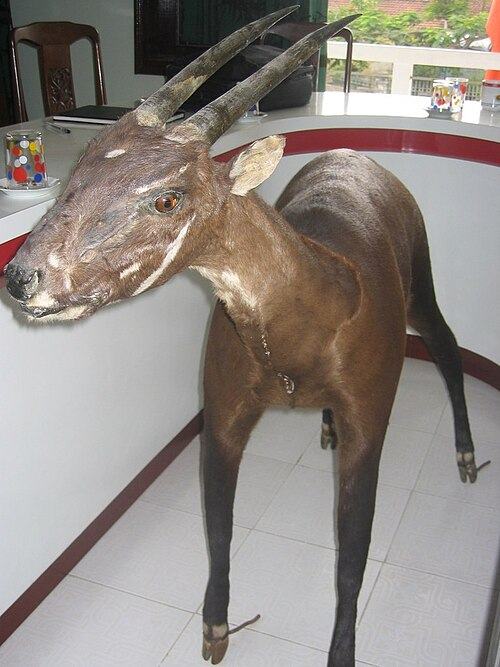
In May 1992 staff from Vietnam's Ministry of Forestry and WWF surveyed Vu Quang Nature Reserve near the border with Laos. Their purpose was to investigate forest biodiversity. The surprise appeared neither in a camera image nor across a clearing, but in hunters' houses: long, nearly straight horns belonging to an unfamiliar bovid. The original scientific report describes three sets of horns. These first specimens lacked teeth, preventing some important anatomical comparisons. Nevertheless, the trophies were physical objects that could be examined and followed up. They supplied a starting point for an investigation rather than merely a striking description.
From trophies to a series of specimens
Vietnamese researchers made four follow-up visits, searching for additional remains and surveying neighbouring Nghe An province. By the time they prepared their Nature paper, they had examined more than twenty specimens and partial specimens. These included three complete upper skulls with teeth and two lower jaws with teeth. The sequence distinguishes the saola story from an account resting on a single memorable sighting. Initial horns raised a question; further material made that question testable. Different anatomical parts consistently supported the identification of a distinct animal, rather than a revised label for an otherwise familiar hunting trophy.
The description followed the discovery
The paper A new species of living bovid from Vietnam appeared on 3 June 1993. Thus 1992 dates the survey discovery, while 1993 dates the formal publication. The animal received the name Pseudoryx nghetinhensis, and its presence was subsequently confirmed in Laos on the other side of the mountain region. The popular nickname Asian unicorn expresses how difficult it is to encounter. Anatomically, however, it can mislead: saola have two long horns. The discovery did not turn the traditional mythical unicorn into a zoological fact. It expanded knowledge of living forest mammals in a particular under-investigated landscape.
After the international sensation
A less celebratory chapter followed the discovery. WWF describes evidence from remains, a small number of camera-trap photographs and several captured animals that survived only briefly. This does not make the species a creature existing only on paper. It demonstrates difficulties in observing it and maintaining animals in captivity. Wire snares set for various forest animals are especially dangerous. A rare saola can die without anyone deliberately hunting that species. Conservation consequently involves local communities, reducing trapping and protecting forest habitat. Detailed knowledge of its behaviour remains much less complete than the evidence establishing that the animal exists.
Comparing the evidence
The original paper documents the specimens and the identification process, while WWF and the Saola Working Group add the history of subsequent searches and protection. Together these sources establish a real species. They do not support a supernatural animal or a general validation of cryptid reports. A distinctive feature is the passage from hunters' knowledge to a description available for international scientific examination. The archive presents the saola as a genuine zoological surprise. Rare encounters do not amount to doubt about its existence, just as confident classification does not mean that every aspect of its life has already been understood.


