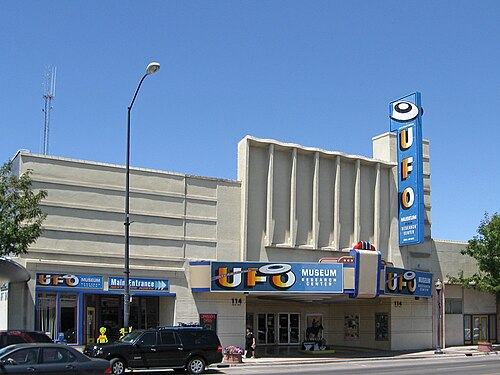
Debris before the legend
In July 1947 debris found on a New Mexico ranch came to the attention of military personnel at Roswell. It happened amid nationwide interest in unusual flying objects. On July 8 the base announced recovery of a 'flying disc,' after which higher command presented the material as balloon and equipment remnants. This abrupt change in language became the story's enduring core. That documented contradiction is sufficient reason for investigation; details from much later accounts of a vehicle and its occupants should not all be inserted into the original recovery.
Why the materials could look unfamiliar
Postwar balloons served more than ordinary weather observation. Project Mogul developed balloon trains carrying acoustic equipment intended to detect distant nuclear tests. Its purpose was classified, while lightweight materials and radar reflectors could look unlike a conventional aircraft. The later Air Force investigation compared descriptions of the finds, photographs and information from program participants. Its explanation associated the debris with such balloon technology. This reconstructs the origin of particular material; it does not declare that every unfamiliar object found in a desert automatically belonged to Mogul.
The story changed over decades
Later accounts made Roswell a story about alleged bodies, transportation and government secrecy as well as debris. The order in which those details appeared matters. Someone remembering decades later might combine separate tests and rumors; a shared military setting does not establish one date and one cargo. Claims about bodies therefore cannot silently be transferred into the 1947 press release. In the 1990s the question acquired another official form: Congressman Steven Schiff sought a search for surviving records, rather than merely a repetition of an earlier brief explanation.
The GAO search and Air Force investigation
A records search began in 1994 in response to the General Accounting Office. The National Archives reports that it could not locate documentation discussing the Roswell episode within Blue Book records. This is a specific archival limitation, not proof that no relevant traces exist anywhere. The Air Force examined different archives, interviewed participants and produced a substantial report on the debris. GAO issued its own account of the search in 1995. Some old administrative records were found to have been destroyed; those gaps describe the state of the holdings without establishing the contents of missing documents.
The separate question of 'bodies'
In 1997 the Air Force published a follow-up addressing accounts of bodies, anthropomorphic dummy tests and other military incidents. A crucial qualification is that later tests cannot be dated to 1947 simply because they occurred in the same region. The official argument involved possible conflation in recollection, rather than future equipment somehow appearing on the ranch. Nor is this report a physical examination of a supposed extraterrestrial specimen. It considers the origins of stories, whereas the 1994 investigation primarily addressed debris and the classified balloon context.
Comparing the sources and conclusion
The archival guide, GAO audit and Air Force studies perform different jobs: one describes holdings, another checks the search, and the others propose historical reconstructions. Their agreement supports a balloon explanation for the original recovery without resolving every later recollection precisely. An extraterrestrial-vehicle hypothesis would require testable material with provenance and independent documentary support. The cited searches did not establish such evidence. Roswell remains an important history of classified technology, failed public communication and expanding legend. These documented processes explain its persistence without treating alien visitors as an established fact.


