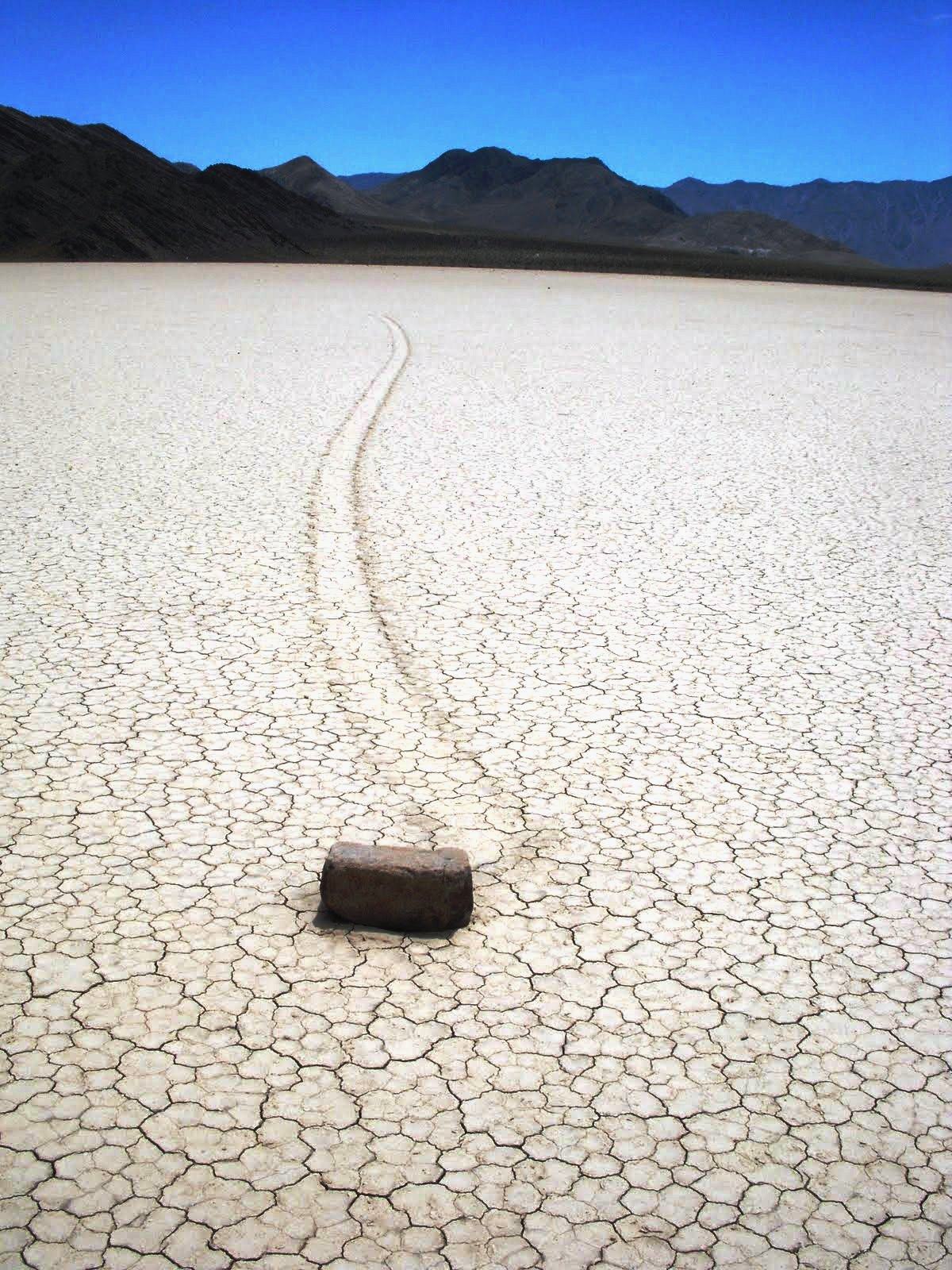
The tracks were visible, the movement was not
Across the nearly level dry lakebed of Racetrack Playa in Death Valley, stones sit at the ends of long furrows. Some tracks run together, while others turn or diverge. On an ordinary dry day nothing suggests why heavy objects should have moved there. Researchers had debated the problem since the 1940s, considering wind, water and different roles for ice. A photograph of a stone at the end of a track did not show the process itself. Movement was well supported, but its precise conditions and the coordinated behaviour of different stones were much less securely understood.
Instrumenting a long wait
In 2011 a team installed a weather station and prepared fifteen stones with GPS instruments activated by movement. The National Park Service did not permit modification of native stones, so similar rocks brought from elsewhere carried the equipment. Cameras supplied images alongside position and weather measurements. The experiment could have required years of waiting: an appropriate winter would not necessarily coincide with an expedition. Researchers wanted a sequence of conditions rather than another collection of attractive tracks. Otherwise wind, wet mud and ice would remain plausible participants whose exact interaction had never been observed directly.
Water, freezing nights and breaking ice
In December 2013 a shallow pond covered part of the playa. Its surface froze at night, and thin ice began breaking during the day. Richard and James Norris happened to be present during these events. Large panels only a few millimetres thick moved under light winds and pushed stones protruding through the water across wet clay. The observed process therefore did not require a hurricane capable of shifting a dry boulder unaided. It depended on a combination of shallow water, freezing, subsequent warming and wind. Without water there would be no ice; a different pond depth would alter how stones and panels interacted.
Slow and collective movement
The 2014 paper describes the largest recorded event on 20 December 2013, when more than sixty stones moved. Across several events between December and January, some instrumented stones accumulated movements of as much as 224 metres. Observed speeds were approximately two to five metres per minute. This was not an abrupt leap, but motion an observer could easily overlook, particularly if neighbouring objects were moving together. Wind, water currents beneath the ice and the breakup of panels affected direction. These observations helped explain matching sections of tracks and occasions when nearby stones began to follow different routes.
Comparing the old puzzle with new evidence
The earlier PBS account documents a previous stage of discussion; the Norris paper and updated park account describe a mechanism actually observed. Treating all these sources as if every detail had already been established before the experiment would distort the history. The newer study also does not provide an exact biography for every old trail or claim that stones in every desert move identically. It explains measured movements at a specific site. The archive includes this as a transition from persuasive traces to an observable event: an extraordinary-looking result arose from an unusual combination of ordinary conditions that researchers eventually witnessed and measured.


