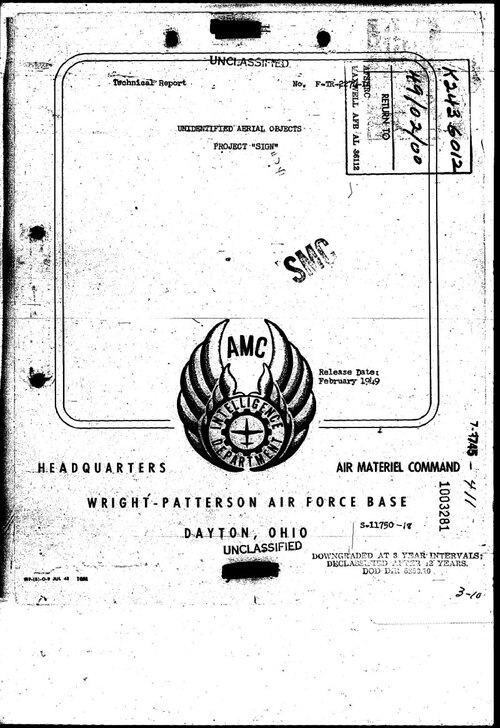
Why the military wanted a separate program
During the summer of 1947 unfamiliar-object reports arrived from civilians, pilots and military personnel. At the beginning of the Cold War, the issue was not confined to possible visitors from space. An adversary's new technology, misunderstood tests and real air threats also required investigation. Air Materiel Command requested formal authority that autumn. A late-December directive organized collection and evaluation, and work began under the name Sign in January 1948. The program therefore emerged from a specific technical-intelligence problem, rather than an already proven discovery of extraterrestrial machinery.
Wright Field assembled scattered observations
Responsibility went to Air Materiel Command's technical intelligence organization in Ohio. Different services and agencies were asked to supply information; witnesses would be interviewed and findings circulated to interested organizations. An isolated letter about a luminous point could become a case recording place, time, direction and circumstances. A formal reporting form nevertheless could not repair missing information retrospectively. If the observer did not know the range, headquarters did not automatically acquire it. Early documents already acknowledged unpredictable events and a shortage of precise observational details.
What investigators compared with reports
Investigators considered conventional aircraft, balloons, weather and astronomical events. The report lists maps of airlines, airfields, radio beacons, radar facilities and weather stations, alongside celestial-event information. Foreign technology and developments potentially available to an adversary were another concern. These were specific, testable comparisons. Matching a sighting with a known flight could reduce uncertainty; failing to find a suitable aircraft did not establish a cosmic origin. The program attempted to sort heterogeneous accounts among explanations, rather than investigating one physical object whose identity had already been defined.
Why different totals appear in the history
Hector Quintanilla later described evaluation of 243 cases and completion of Sign's work in February 1949. Another document gives 256 registered incidents as of March 10. This need not be a contradiction: different cutoff dates and the distinction between registration and completed analysis produce different totals. The records also describe decisions to rename the project Grudge. A program name, an order's date and preparation of a final text do not always coincide. The history is better understood as successive administrative actions than a single sudden change in scientific judgment.
The disputed 'Estimate of the Situation'
Later literature gives special prominence to an allegedly prepared Sign document called Estimate of the Situation, said to favor an interplanetary interpretation. It is generally associated with internal disagreement and leadership's rejection of that interpretation. This account cannot carry the same evidential weight as an accessible signed report if its text is unavailable for examination. Even a staff member's preferred hypothesis would not constitute a specimen of unknown material. Securely available documents show serious interest, terrestrial explanations and acknowledged uncertainty, without allowing every internal discussion to be reconstructed.
Comparing the records and conclusion
A contemporary report describes what was collected and how investigation was organized. CIA retrospectives explain institutional development, while the archival guide directs readers to surviving cases. These layers are not independent confirmations of every sighting. Sign matters as an early systematic governmental response to a new mass stream of reports. Its records do not establish extraterrestrial technology, but neither require pretending the questions were never investigated. Our assessment is that the investigation was real, its findings were constrained by testimony quality, and intelligence secrecy itself did not determine the nature of what was being studied.


