The suspiciously inexpensive house
In a letter to Licinius Sura, Pliny the Younger asks whether apparitions have an existence of their own or receive their shape from human fear. One example concerns a spacious house in Athens that nobody wished to occupy. At night its inhabitants heard the noise of iron, first at a distance and then approaching. An emaciated old man appeared, with a long beard, disordered hair and chains on his hands and feet. In Pliny’s account, the occupants lost sleep, fell sick through fear and eventually died. The house was abandoned, although a notice offering it for sale or rent remained, in the hope of attracting somebody unfamiliar with its reputation.
The philosopher continues writing
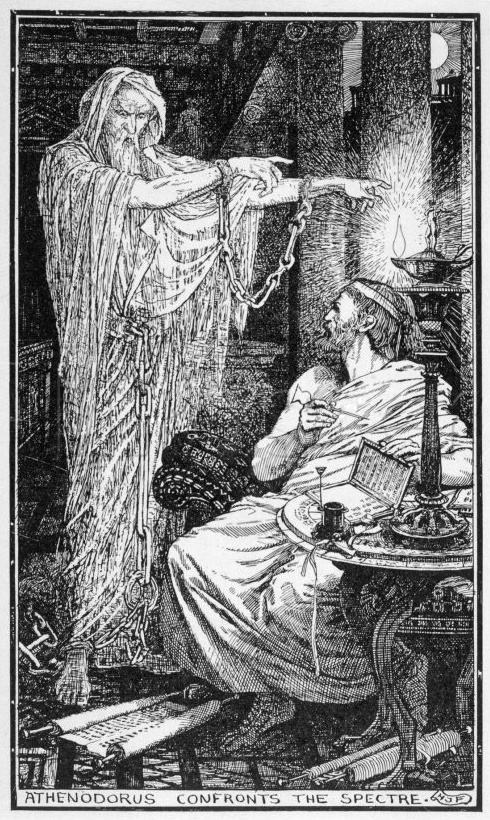
When Athenodorus came to Athens, the low price made him suspicious. He asked questions, heard the explanation and nevertheless rented the property. That evening he requested a couch in the front part of the house, a lamp and writing materials. He sent the other people into the inner rooms and concentrated on his work, preventing an unoccupied imagination from supplying the terrors he had been told to expect. When the chains sounded, he initially kept his head down. Eventually the figure stood before him and beckoned with a finger. The philosopher gestured that it should wait and returned to his writing. Only when the chains rattled above his head did he take the lamp and follow.
A night-time direction and a daytime burial
The old man moved slowly, as though impeded by the iron. In the courtyard he abruptly disappeared. Athenodorus marked the spot with plucked grass and leaves so that he could find it in daylight. The following day, Pliny continues, the philosopher approached the magistrates and requested an excavation. Human bones entangled in chains were discovered; the flesh had long since decayed. The remains were collected and buried at public expense. After proper funeral rites, the conclusion states, the house was troubled no more. Pliny does not name the deceased, explain his imprisonment or identify the property’s precise address. Assigning him a particular murder or secret trial would add a story absent from the surviving letter.
Why the letter’s form matters
The Athenian episode stands among other extraordinary stories with which the author develops a question for an educated correspondent. Pliny does not present himself as an occupant of the house or a participant in its excavation. Athenodorus is portrayed as somebody who investigates a rumour while retaining composure: he considers a price, observes an apparition, marks a location and consults public officials. This sequence lends the narrative credibility, but it remains a sequence within a carefully shaped report. Its ending simultaneously accounts for the rattling chains and the dead man’s supposed restlessness. The supernatural visitor becomes an intelligible claimant for the burial he was previously denied.
Comparing the text with what can be established
The Latin text and historical translations allow this sequence of actions to be checked; Dickinson College’s commentary explains the language concerning the courtyard, leaves and public burial. Agreement between translations reflects a shared source, rather than several independent witnesses. The letter securely establishes the existence of an ancient ghost narrative and a discussion of visions. It supplies no surviving remains, excavation report or separate testimony from Athenodorus. The date of the letter is consequently not assigned as the date of the haunting, and the unidentified house receives no point on a modern map.


