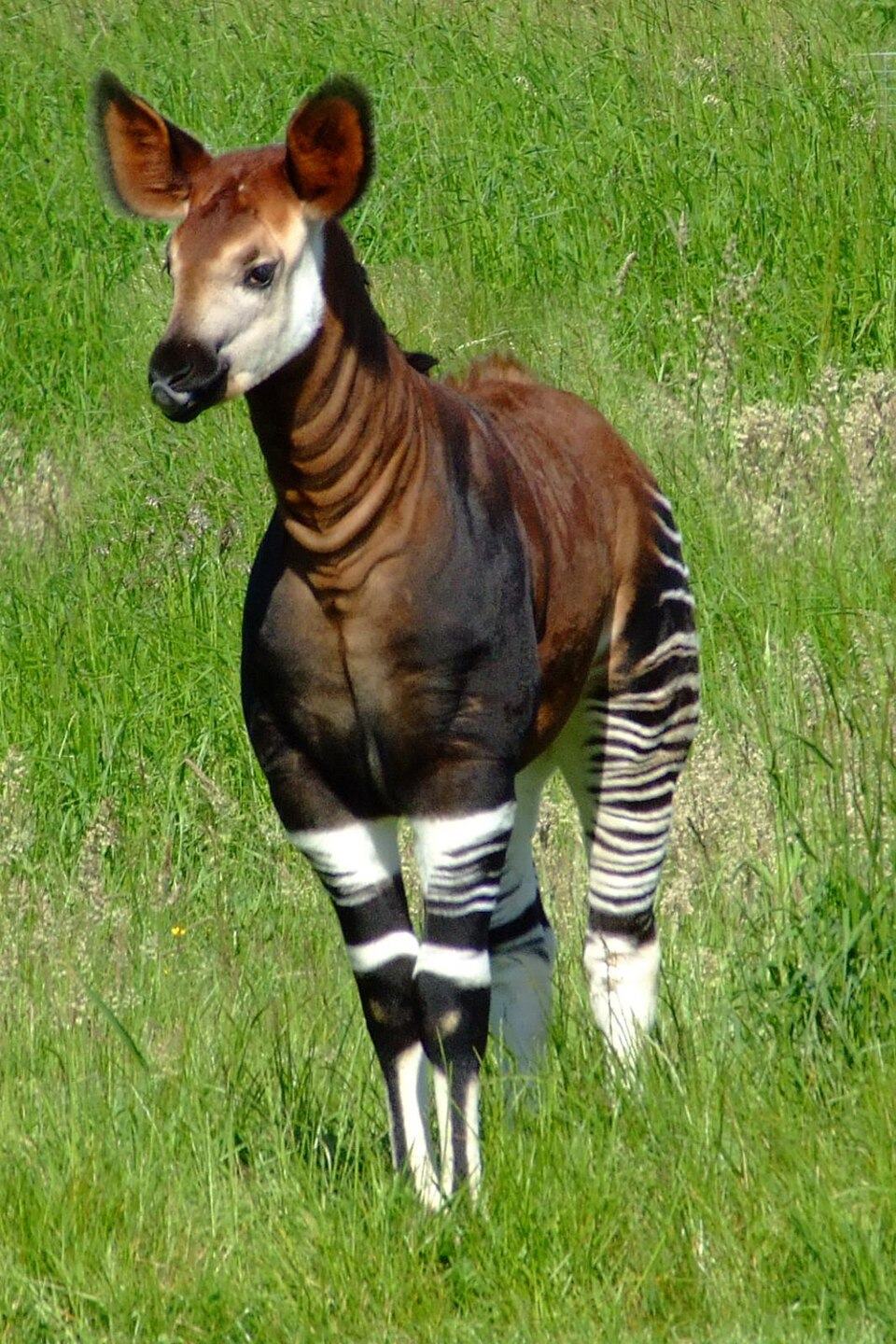
An animal that already had a name
During the late nineteenth century European travellers brought reports of an unfamiliar animal from Central African forests. Its stripes suggested a zebra in several retellings. For forest communities, however, the okapi was not a creature known only from a passing rumour. It was an animal with a local name and an established place in local knowledge. The Royal Museum for Central Africa explicitly distinguishes European ignorance from what Congolese people already knew. Calling it unknown therefore requires a qualification: it was unfamiliar to a particular scientific community, rather than to every human observer.
Two pieces of hide suggest the wrong family
Harry Hamilton Johnston began pursuing the animal in 1899. His first important material consisted of two striped pieces of skin, obtained through colonial intermediaries that included military personnel. The IUCN historical account records their exhibition in London in December 1900. Early the next year Philip Sclater proposed Equus johnstoni, provisionally placing the animal with horses and zebras. The striped pattern offered a plausible clue, but small pieces of hide could not reveal the anatomy of an entire mammal. The specimens were genuine; their initial interpretation was incomplete. That distinction is central to understanding the episode.
What the skulls changed
In 1901 Johnston obtained a complete skin and two skulls through Karl Erikson, a commander at Beni. Researchers could now compare more than a pattern in the coat. The new material showed that the animal was related to giraffes. Ray Lankester participated in revising its identification, and the name Okapia johnstoni became established. This was not a succession of two different mysterious beasts. Different sets of remains allowed different levels of anatomical certainty. Preserving the material also enabled subsequent specialists to inspect the underlying evidence, rather than merely repeat the confidence of an explorer or the excitement of a newspaper report.
The cost of scientific and national prestige
Identification led to European competition for specimens. The museum at Tervuren records acquiring 37 between 1902 and 1908. Live okapis were later shipped to zoos, and early transfers frequently ended in short lives in captivity. The museum's provenance account places these activities within the pursuit of colonial prestige. Reducing the story to the adventure of one explorer conceals the work of local people and the circumstances under which bodies were obtained. Examining that history does not erase the anatomical findings. The provenance of an animal and its biological identification are connected but distinct subjects of inquiry.
What this discovery actually demonstrates
The museum account, conservation review and ZSL histories support a coherent sequence: local knowledge, incomplete specimens, more complete remains and revised classification. This is a strong example of a large mammal receiving late recognition in international zoology. It does not establish that every modern report of a forest creature will lead to a similar discovery. Each proposed species requires its own inspectable material. In this archive the okapi is explicitly an established animal and a historical comparison. The remarkable element is how knowledge travelled between communities and institutions, rather than continuing uncertainty about whether the animal exists.


