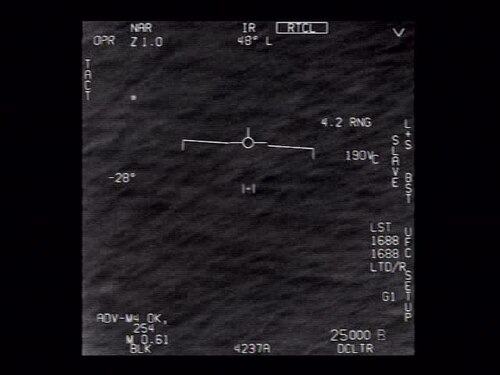
January 2015: the impression of extraordinary speed
In GOFAST, a small high-contrast target appears to race almost directly above the ocean. The impression is persuasive because the water moves rapidly behind an object held by the tracking camera. However, the background lies farther away than the target, and the camera is aboard a moving aircraft. The display therefore combines observer motion, changes in viewing direction and any actual movement of the object. These contributions must be separated before unusual flight performance can be inferred. GOFAST describes the visual impression, not a measured speed.
Why distance changes the interpretation
Parallax occurs when nearby and distant features shift relative to one another as an observer moves. Here it can create the appearance of rapid flight just above the water even if the target is substantially higher. Geometry is particularly important because the video supplies no familiar visual scale. A target appearing against the sea does not establish that the distance between it and the surface is small. Testing that assumption requires numerical information from the targeting display, rather than an intuitive estimate based on the moving background.
NASA's useful but approximate calculation
The NASA independent study team's 2023 report uses GOFAST to illustrate how information can be extracted from display data. Using aircraft altitude, viewing angle and target range, it calculated a target altitude of roughly 13,000 feet. Its approximate motion analysis produced a speed near 40 miles per hour. The report explicitly notes that it neglected wind effects on the aircraft, introducing uncertainty. That number should therefore not be treated as a definitive precise speed. Its important result is narrower: the footage does not require an object racing extraordinarily fast along the sea surface.
What AARO added in 2025
On 6 February 2025, AARO released a dedicated case analysis. It likewise estimated an altitude around 13,000 feet and assessed with high confidence that the target showed no anomalous performance. Its calculations explored aircraft-heading possibilities and wind effects. The resulting estimated ground-speed range was approximately 72–161 miles per hour. Removing the wind contribution produced an approximate range of 5–92 miles per hour. These are conditional outputs from a model, not several conflicting direct readings of the same instrument. Their interpretation depends on which motion and reference frame are being discussed.
What remains unidentified
AARO explicitly states that it cannot definitively identify the object. Explaining apparent speed does not prove that the camera recorded a particular balloon, bird or vehicle. Nor can motion relative to the air be compared with motion relative to the ground without stating the distinction. Differences between NASA's illustration and AARO's analysis should be understood through their assumptions: the more detailed model includes influences omitted from the simpler example. Scientific accuracy means keeping those qualifications alongside the numbers, rather than selecting whichever value makes the strongest headline.
Editorial assessment: an effect explained, an object unnamed
Our assessment from the two analyses is that the original extraordinary-speed claim depended on transferring the background's apparent motion to the target. Reconstructing the geometry substantially weakens the claim of exceptional performance while leaving exact identification open. That is meaningful progress even without a final object label. The case illustrates why an explained status should attach to the claim actually tested: here, supposedly anomalous motion. It should not be extended automatically to the target's origin, other Navy recordings or every unresolved UAP report. Additional independent data could narrow the object's identity without restoring the original visual assumption.


