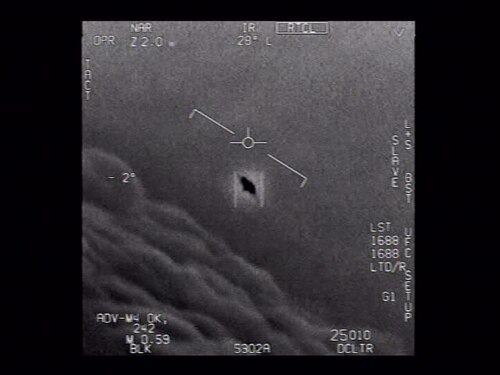
January 2015: what GIMBAL contains
GIMBAL is a short U.S. Navy infrared recording associated with January 2015. A high-contrast target near the center changes its orientation relative to the screen during the clip. The aircrew's reaction makes the scene particularly striking. Three different kinds of material must nevertheless be distinguished: the instrument image, the conversation of people interpreting the situation and later accounts of a broader series of encounters. These can inform one another without having identical evidential weight. Treating all three as one uninterrupted measurement is a major source of confusion around the video.
An image turning versus a vehicle rotating
The elongated patch genuinely changes its direction on the display. Establishing that a solid vehicle rotated in the same way requires determining which features belong to the target and which arise within the imaging system. Infrared brightness, glare and processing can affect a visible outline. Asking about optical effects is therefore reasonable. But proposing a possible instrument effect is not the same as identifying this particular target. A convincing explanation should reproduce the observed behavior with appropriate data, rather than rely on an unrelated example that merely looks similar.
What the aircrew's words establish
The audio preserves the participants' surprise and their working interpretation of what they were seeing. References to additional objects cannot automatically be treated as published measurements of an entire formation: the released segment supplies no separate track for each reported contact. Ryan Graves's congressional statement provides useful context about reports from East Coast training areas, pilots' concerns and reporting difficulties. It should not make him the operator of the GIMBAL camera. Nor should incidents described elsewhere in his testimony be assigned to this recording without a documented connection between them.
Official release and unresolved status
The Pentagon officially published three historical Navy videos on 27 April 2020 and characterized the phenomena as unidentified. AARO's public imagery collection also presents GIMBAL as an unresolved case. Such a label describes the outcome of an institutional review; it is not a measurement of the object's physical capabilities. It establishes neither that an ordinary explanation is impossible nor that unusual technology has been detected. Similarly, GIMBAL is the recording's familiar name. The name itself should not be promoted into a completed technical diagnosis of the rotation.
Why a striking frame cannot settle the physics
Without reliable range information, estimates of size and speed depend on assumptions. A small nearby object and a large distant one can occupy the same area on a screen. The recording platform is also moving and turning. A physical reconstruction therefore needs camera angles, tracking behavior, aircraft motion and independent information about the target. NASA's methodological report emphasizes calibration and metadata for precisely this kind of measurement problem. That general scientific standard is useful here, but it should not be misrepresented as a NASA finding that resolves GIMBAL itself.
Editorial assessment: test a specific claim
Our assessment is that the most useful question is whether the clip requires an unusual vehicle to rotate, or whether viewing geometry and camera behavior can reproduce the effect. Even a successful answer would not necessarily name the object or explain every encounter reported by the squadron. The case becomes clearer when divided into file provenance, image formation, trajectory and identification. Official release establishes the first. The others require additional evidence and explicit uncertainties. Remaining uncertainty keeps the investigation open; it does not automatically favor whichever extraordinary explanation happens to be proposed.


