November 2004: two separate episodes
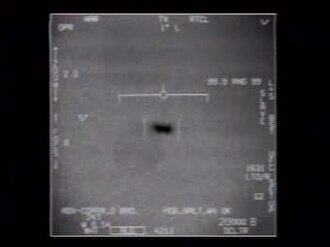
The FLIR story belongs to the USS Nimitz carrier group's training operations off the western United States in November 2004. Popular accounts often compress it into one continuous encounter, simultaneously witnessed by pilots, tracked by shipboard radar and recorded on camera. The public documents support a more careful chronology. In his written congressional statement, David Fravor describes his own visual encounter and then says that another crew, launching afterward, recorded the familiar infrared video. Combining these episodes into a single controlled measurement would overstate the evidence.
What Fravor reported
According to his 2023 statement, a training flight was redirected toward a contact tracked by USS Princeton. The aircrews saw a white elongated object above disturbed water, without discernible wings. Fravor described approaching it, a change in its motion and a rapid disappearance. He learned of a contact subsequently appearing at the combat air patrol point from the ship's controller. His description of the object's appearance is therefore firsthand, while part of the radar narrative is information relayed by other participants. The statement documents that testimony; it does not supply the underlying radar measurements.
What the recording actually contributes
FLIR provides an actual sensor image that researchers can inspect for target position, display changes and tracking behavior. This is more concrete than an oral account alone. Nevertheless, a dark infrared patch is not a detailed photograph of an aircraft's structure. Its appearance depends on resolution, contrast, optics and display settings. Without independent range information and a synchronized timeline, movement across the screen also cannot be converted directly into physical acceleration. A target leaving a tracking box does not, by itself, measure an extraordinary burst of speed.
What the Pentagon authenticated
On 27 April 2020, the Department of Defense authorized the official release of FLIR, GIMBAL and GOFAST. It established their provenance as Navy recordings and described the phenomena as unidentified at that time. This matters: the government acknowledged the material rather than merely commenting on an internet reconstruction. But the authenticity of a recording, the accuracy of each interpretation made during an encounter and the origin of the target remain separate questions. Official publication chiefly addresses provenance. It does not automatically validate every physical claim associated with the footage.
What would move the investigation forward
The most useful addition would be a synchronized evidence package: original shipboard radar tracks, aircraft positions, the original video with sensor metadata and separately documented accounts from the crews. Researchers could then test whether different contacts represented one target, reconstruct the geometry and quantify uncertainties. This approach presupposes neither deception nor advanced technology. It defines the conditions under which a report of abrupt motion could become a reproducible calculation that investigators with different starting assumptions could independently assess. Public confidence would improve through that chain of evidence rather than through professional credentials alone.
Editorial assessment: an important but incomplete reconstruction
Our assessment is that the case's significance comes from named witnesses, its operational setting and an acknowledged recording. The public narrative nevertheless joins evidence with different levels of independence and testability. FLIR remains interesting as an incomplete reconstruction. It does not establish an extraterrestrial craft, while criticism of one video frame cannot automatically explain everything Fravor described. The productive next step is agreement between independent measurements. Additional retellings of the same account, however sincere or detailed, cannot substitute for the missing connection between the visual encounter, radar contacts and later recording.


