How an unusual stone became a laboratory archive
A space object broke apart above Murchison, Victoria, on 28 September 1969. Residents witnessed the fall and collected numerous fragments. The story matters beyond the spectacle: material reached researchers soon after falling. For organic-compound analysis, that is a substantial advantage over a stone left in soil for an unknown interval without a documented history.
One object, many specimens
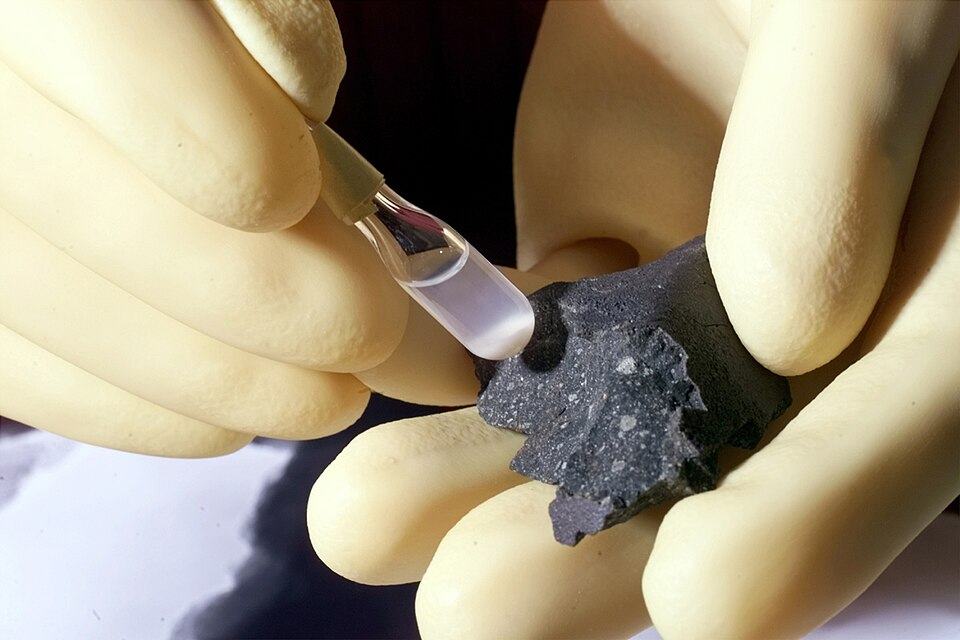
Museums Victoria explains that “the Murchison meteorite” refers to many fragments of one body. Recovered material was distributed among scientific collections in Australia and abroad. A photograph of a small museum specimen consequently shows neither the asteroid's original size nor the entire available sample. The map marks the locality and fall region; individual specimens are now held far away.
Distribution between collections permits investigation in different laboratories. It also requires careful documentation: which portion was studied, how it was stored and how it was treated. Two analyses sharing the meteorite's name do not necessarily concern identical pieces. This is not a reason to reject results, but a reason to read specimen descriptions before comparing concentrations, composition and conclusions across papers.
What chemists found
A 1971 study described nonprotein amino acids in Murchison. Some compounds were identified confidently, while others received tentative identifications. The distinction is useful: sound scientific writing need not assign identical certainty to every signal. Later work continued investigating its organics, and NASA Goddard's laboratory uses Murchison as an example of chemically rich carbonaceous material.
In this chemical context, “organic” concerns carbon compounds rather than necessarily biological origin. An amino acid can participate in terrestrial biochemistry while also forming without a living organism. Finding such molecules in a meteorite is therefore not equivalent to finding microbes. A collection of precursor substances and a reproducing cell remain separated by many questions about processes, conditions and material history.
Why contamination is tested
The terrestrial environment is also rich in organics. Researchers must show that a measured signal belongs to the meteorite rather than soil, hands, packaging or laboratory reagents. A 2019 paper on sugars discusses control comparisons and isotopic composition. This tests a substantive alternative, rather than fulfilling a formality: without it, even a sensitive instrument can accurately measure something unrelated to the original extraterrestrial sample.
Explanation does not remove the scientific interest. The real question concerns reactions within cosmic material and what such material could have delivered to early Earth. Answering requires independent methods, controls and comparisons among meteorites. Murchison demonstrates rich extraterrestrial chemistry while preserving a clear boundary between precursor molecules and life. That boundary allows the discovery's actual significance to be assessed without either exaggerating or dismissing it.


