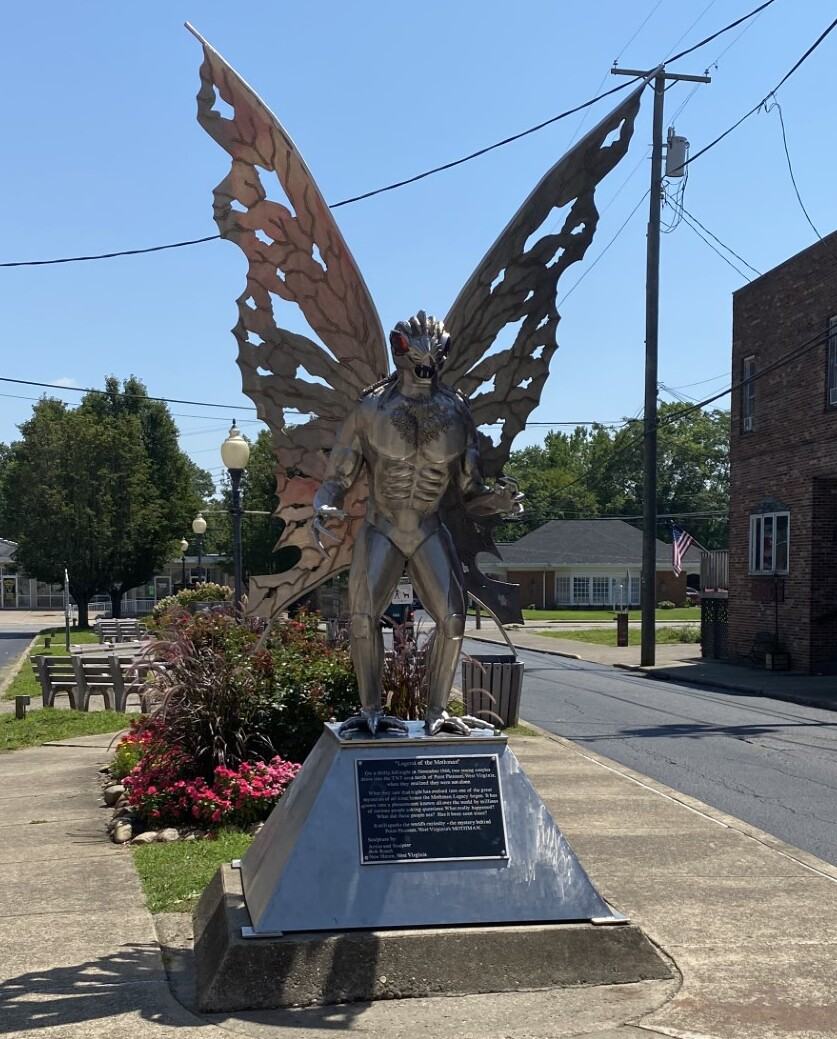
Two couples in the TNT area
In November 1966 the surroundings of Point Pleasant became associated with reports of a large winged figure with red eyes. The best-known episode involved two young couples, the Scarberrys and the Mallettes, on a road near a former military manufacturing complex locally called the TNT area. In a later account given by museum representative Ashley Wamsley Morrison to the West Virginia Folklife Program, the witnesses initially thought they were seeing a person. Their story then described wings and a figure flying above their car. This preserves local memory of the encounter, but is a retrospective interview rather than a contemporary measurement record.
The night produces further searches
In the museum family’s account, the young people went to the sheriff’s office after the encounter and officers accompanied them back. Morrison explained that the witnesses pointed toward the figure, while the officers themselves did not see it. This distinction matters: a police response establishes that a report prompted action, without providing independent zoological identification. Abandoned structures and dark roads subsequently attracted more visitors. Some residents were frightened, while others wanted to hunt the creature. The West Virginia Encyclopedia describes approximately twenty-six reports over a year, concentrated around the former munitions site and the surrounding Point Pleasant region.
Birds, investigators and correspondence
Proposed ordinary explanations included a wandering sandhill crane. In a 1966 newspaper letter, the future writer Breece D’J Pancake suggested a California condor. These proposals document the contemporary debate; neither constitutes a definitive identification of the original stimulus. Writer John Keel investigated a broader collection of claims involving UFOs and malfunctioning equipment. According to the museum interview, he maintained correspondence with Linda Scarberry and journalist Mary Hyre, material later held by the museum. Such documents illuminate relationships between participants, but a letter about an unusual experience is not equivalent to a biological specimen of its alleged cause.
A bridge becomes part of the legend
On 15 December 1967 the Silver Bridge across the Ohio River collapsed, killing forty-six people. Keel’s 1975 book The Mothman Prophecies connected the disaster with unusual stories surrounding the town, and its subsequent film adaptation reinforced that association. The National Transportation Safety Board, however, reconstructed a structural failure beginning in suspension-chain eyebar 330. The Federal Highway Administration likewise identifies an eyebar crack and describes how the tragedy contributed to a national bridge inspection system. That engineering history rests on damaged structural material and a failure sequence; an alleged flying warning figure is not needed to explain it.
Comparing accounts with physical evidence
The folklife interview, encyclopedia and museum correspondence demonstrate the story’s lasting social existence. They do not establish an unknown winged animal. Bird misidentification is a plausible explanatory category, but the available material cannot assign every reported episode to a particular species. For the bridge collapse there are examined components and an engineering reconstruction, an entirely different evidential foundation. Temporal proximity alone cannot turn the two narratives into a causal relationship. This entry preserves the reports of 1966–1967 and their cultural development, while treating the supposed prediction of disaster as part of the legend rather than a finding of accident investigation or zoology.


