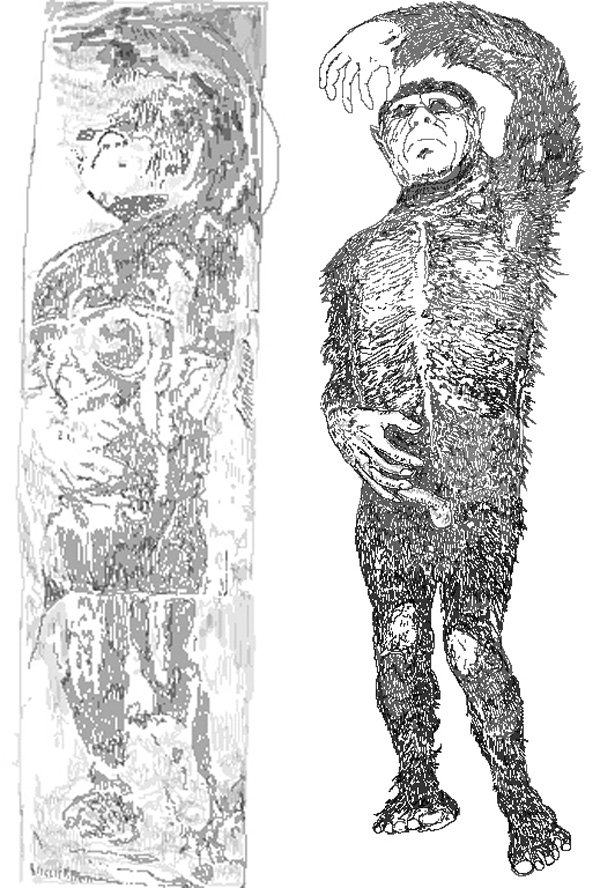
A figure behind glass
In December 1968 Bernard Heuvelmans and Ivan Sanderson visited Minnesota to examine an unusual sideshow exhibit associated with Frank Hansen. A hairy humanlike figure lay beneath glass and ice. Hansen charged admission and presented its origin as a mystery. The Smithsonian Torch reported in spring 1969 that the exhibit had appeared at fairs since 1967 and dated the researchers’ visit to 17 December. This provides an important starting point: a contemporary institutional account of an exhibited object, rather than only a later internet story about an unknown human supposedly recovered from a remote frozen wilderness.
Observation without an autopsy
The investigators viewed the figure through barriers rather than performing a complete anatomical examination. Thick hair, a broad chest, large hands and apparent injuries to the head and arm attracted their attention. Heuvelmans considered it a possible previously unknown human form and published a description; Sanderson also regarded the find seriously. Yet visual plausibility and the observers’ reputations could not replace access to tissue and bone. Ice restricted attempts to verify the very features producing the sensation. An apparent wound remained an interpretation of a visible surface until the object could be independently examined and sampled.
Why the Smithsonian became interested
Primatologist John Napier received information about the exhibit and thought it deserved investigation. The Smithsonian Torch printed an account of Secretary Dillon Ripley’s request for FBI assistance in identifying the owner and locating the object. The possibility of a human body, inflicted injuries and overseas importation explained the federal approach. Crucially, the request aimed to determine whether the object represented a fabrication or a discovery. Later retellings can turn institutional interest into an endorsement that never occurred. The contemporary item records uncertainty and an effort to obtain access; it does not announce a new species or a completed autopsy.
A model and a substitution narrative
Later investigations connected the exhibit with the manufacture of an artificial figure by motion-picture effects specialists. A Smithsonian historical timeline describes a prop company acknowledging that it had made an Iceman in 1967. Supporters of the biological interpretation proposed that an authentic body had been replaced with a copy, but that account requires independent evidence for the first body. The familiar exhibit eventually reached the Museum of the Weird in Texas. Zoologist Darren Naish discussed its resemblance to early photographs. Moving a sideshow object into a museum does not make it the reference specimen of an unknown primate or supply the missing independent anatomical examination.
What the comparison supports
The exhibit, its inspection by two prominent writers and the Smithsonian’s genuine interest are securely documented. Evidence of model construction provides an ordinary explanation consistent with the sideshow setting. A concealed authentic body requires an additional unverified assumption. Presenting the Iceman as an established new species would therefore misrepresent the surviving record. The classification here concerns an artificial exhibit, rather than assigning motives to every investigator: an observer could sincerely mistake convincing effects work for biological material. The case demonstrates that initial scientific curiosity was justified as a reason to investigate, while that curiosity itself could neither determine the result nor confirm a sensational interpretation.


