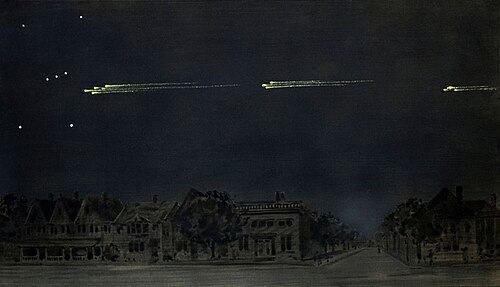
An evening procession instead of a shooting star
On 9 February 1913 people in southern Canada and the northeastern United States saw an unfamiliar movement of lights. Instead of the brief streak of an ordinary shooting star, groups of bright bodies crossed the sky. Witnesses remarked on their comparatively slow motion and orderly formation. Some compared the display with a fleet or airships, familiar images in the early twentieth century. Those comparisons convey an impression rather than establish technological identification. Reports came from different places, and rumbling was heard in some areas. The spectacle became the Great Meteor Procession, investigated long before amateur video cameras could record such events.
Chant investigated something he had not seen
Canadian astronomer Clarence Chant contacted observers and assembled an extensive report in the Journal of the Royal Astronomical Society of Canada. The society's historical study stresses an important distinction: Chant had not witnessed the procession himself. His contribution was collecting, comparing and disseminating other people's observations. Letters, reported directions and drawings helped connect individual experiences into a broader picture. Nevertheless, verbal estimates of height, speed and the number of lights varied. Someone astonished by the spectacle did not necessarily have a clock, compass or independent measurement of distance. The investigation had to work with those limitations.
Gustav Hahn's image enters the archive
Artist Gustav Hahn saw the event in Toronto and created its famous depiction above the city. In 2011 RASC researchers examined how this image had been prepared for reproduction. Its value is not that a painting can replace a photographic negative. It is a visual account by a witness, connected with documents about its production and publication. Colour and composition passed through the limitations of contemporary printing. Modern reproductions should therefore not be measured uncritically as if they were calibrated camera frames. Alongside written reports, however, the image helps explain why contemporaries emphasised the lights' grouping and manner of movement.
Ship records extend the route
Around the centenary Donald Olson and Steve Hutcheon located additional descriptions in maritime records. One important observation from the South Atlantic came from the sailing ship J. C. Vinnen. The historical account hosted by Michigan State University notes that these materials extended the known path to approximately eleven thousand kilometres. The archive thus expanded a century after the actual lights. These were not new observers seeing the event again, but old documents found and connected through research. Their geography imposed stronger constraints on explanations involving only a local explosion over a single city.
Meteors and an uncertain earlier history
NASA describes fragments of a cosmic body travelling along the Earth, while historical discussion included the hypothesis of a temporary natural satellite. The duration, long route and coordinated appearance make a natural train of fragments a substantive explanation. Reconstructing an exact prior orbit from 1913 testimony, however, is more limited than modern instrument-based observation. The card preserves that uncertainty rather than suggesting ships belonging to an unknown civilisation. Comparing the sources supports an unusual real celestial event and a meteoric interpretation; its detailed prehistory remains a reconstruction. Fleet imagery belongs to witness language and must not become independent evidence that the lights were intelligently controlled.


