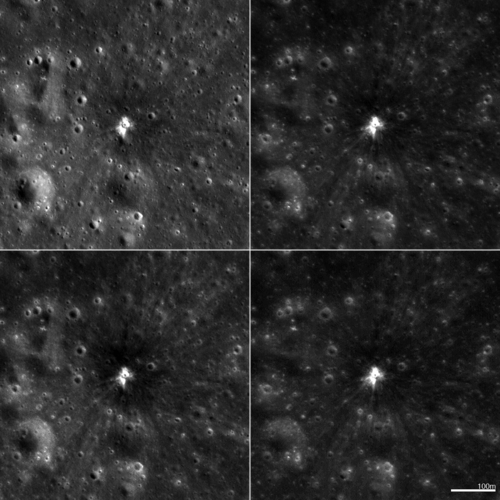
A flash on the lunar night side
On 17 March 2013 NASA’s lunar-impact monitoring programme recorded a bright, brief flash in Mare Imbrium. It was observed from Earth; “night” here means the poorly illuminated portion of the visible lunar disc, where a short light pulse is easier to distinguish. Our point belongs to the lunar surface. It should not be moved to the terrestrial telescope site or interpreted as an observation of something flying above Earth.
Why an impact can shine without air
The word “explosion” often suggests combustion in an atmosphere. During a high-speed lunar collision, light can result from the conversion of motion into heating, melting and vaporisation of material. An atmospheric fire or a spacecraft engine is therefore unnecessary. Researchers use the light signal to estimate impact properties, but those estimates depend on a model: the fraction of energy emitted as visible light is not established by the brightness of one frame alone.
What orbital imaging added
Lunar Reconnaissance Orbiter supplied an important follow-up. Researchers compared images taken before and after the event and identified a fresh crater with bright ejecta. NASA’s research record gives an outer diameter of about 18 metres and a smaller interior dimension when measured from the pre-existing ground level. Different measurement definitions explain why a brief numerical description needs context, rather than a single number selected from a retelling.
Why the coordinates changed
The confirmed crater lies at approximately 20.7135° north and 24.3302° west. An early ground-based localisation of the flash placed the centre of the search area elsewhere. Orbital imaging refined the position on the surface. Our atlas therefore uses the confirmed crater coordinate rather than the original approximate light-location estimate. Even a correctly recognised flash can occupy an extended image patch whose centre is uncertain. This illustrates a normal sequence of investigation: detection, localisation and then a check on the origin of a visible change.
What makes this observation valuable
The flash recording and a new crater are different kinds of evidence that can be compared. Timing constrains when the event happened, while images show a lasting result in the ground. Their agreement is stronger than an unsupported report of an unusual colour or glow. The monitoring programme also records other impacts, allowing this episode to be compared with a recurring class of natural phenomena instead of treating it as a unique exception without context.
What remains uncertain
An established mechanism does not mean that every property of the incoming body is known equally well. Mass, speed and luminous efficiency require separate measurements or assumptions. Refining those quantities does not undo the combined evidence for a collision. When a lunar flash is described online as a sign of unknown technology, the useful initial questions concern the original video and whether investigators searched for a surface change. Here that test led to a particular crater, rather than confirmation of a landing hypothesis.


