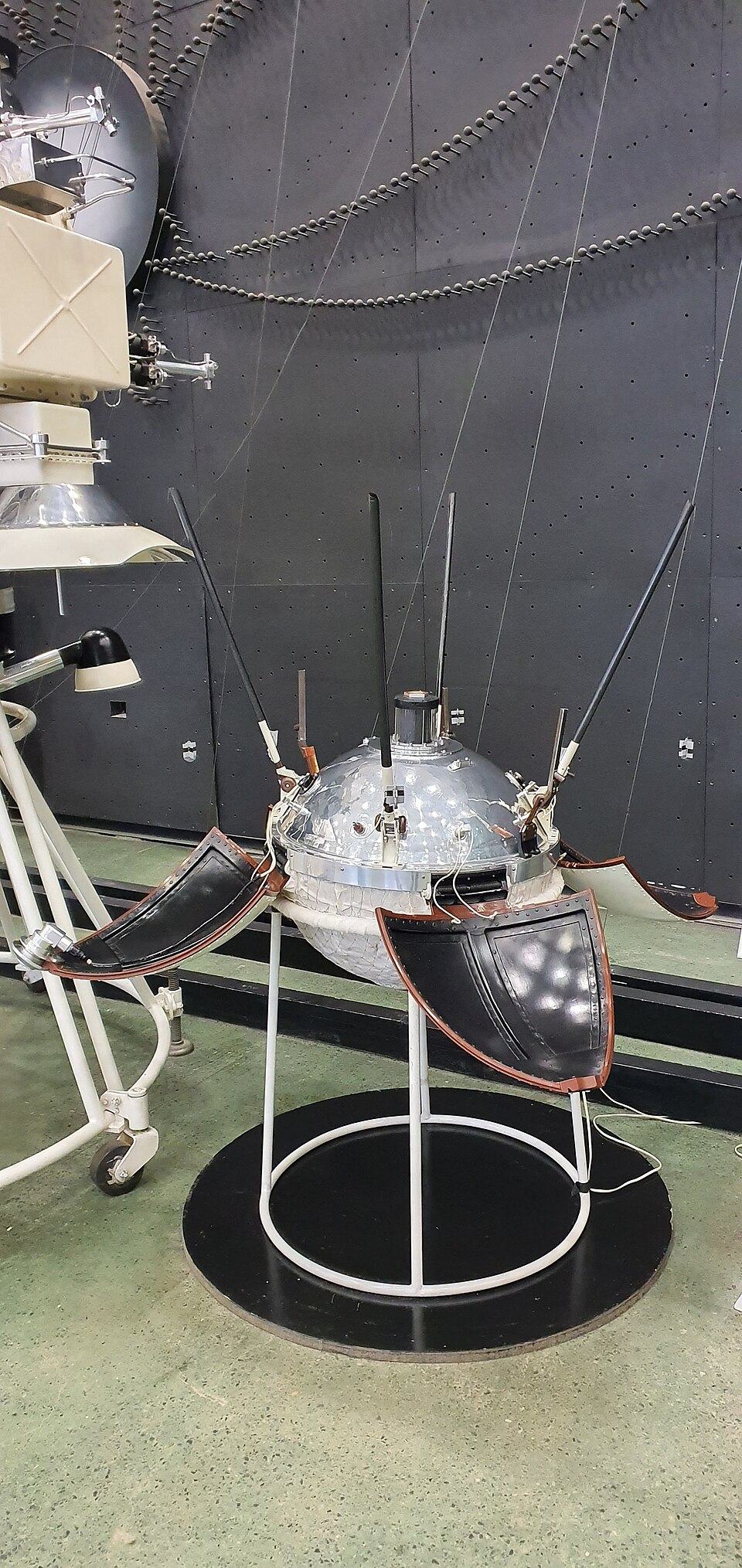
The long road to a soft landing
After impact probes and flyby photography, the next objective was to preserve a working station on lunar ground. That required much more than hitting the Moon: the spacecraft had to lose speed before arrival and protect its instruments against the remaining shock. Luna 9 launched on January 31, 1966 after a series of unsuccessful Soviet attempts. Its operators were not the only people following the flight. Britain's Jodrell Bank observatory already had experience receiving spacecraft signals and watched a mission that might first show the surface from an instrument standing upon it.
February 3 in Oceanus Procellarum
The spacecraft reached Oceanus Procellarum on February 3. A cushioning system protected its landing capsule, and opening structures allowed it to assume its working position after motion stopped. Instead of a final picture before destruction, observers could examine one location over time. The station began transmitting information after landing, while photography required suitable illumination. Historical references differ slightly in landing seconds and rounded coordinates. The established day and region matter here; the marker does not identify a particular meter-sized feature found in a modern photograph.
Rocky scenery rather than bottomless dust
The first images revealed nearby ground, stones and the horizon. They provided practical evidence that the surface at this particular location had supported a capsule and permitted it to operate. This mattered for future landings: concerns about the uppermost layer needed an on-site test. One stable instrument did not, however, measure the bearing strength of the entire Moon or replace investigation of slopes, craters and different soils. The panorama's significance was a specific successful experiment, rather than a universal declaration that every possible landing place would be safe.
A newspaper machine read the transmission
At Jodrell Bank the received signal was recognized as a facsimile transmission. A Daily Express picture receiver was brought in to reproduce it. The observatory's history records photographic reception on February 4 and 5; differences in scanning parameters required the proportions to be reconstructed correctly. An initially stretched picture therefore did not show extraordinary geometry in the lunar horizon. It presented a decoding problem. British publication preceded the Soviet authorities' release and provoked discussion: the observatory received an openly transmitted radio signal, but published the product of somebody else's politically important mission.
A print preserved the reception history
The Science Museum Group preserves a black-and-white copy of the first image received by the Daily Express equipment at Jodrell Bank on February 4. The object has a museum identifier and a defined provenance. The Smithsonian discusses the same episode in the history of the earliest lunar surface views. These records distinguish touchdown from printing and the Soviet camera's operation from British reception. NASA also publishes a surface view from Oceanus Procellarum with its mission attribution. Flight chronology, radio engineering and a surviving physical document together reconstruct the episode.
Comparing the evidence and conclusion
Mission records establish a soft landing, independent reception establishes the transmitted signal, and the museum print shows how it became an accessible photograph. These strands are stronger than a single later recollection. Nevertheless, many published copies of one panorama are not independent photographs. Locating the small capsule precisely in orbital imagery requires separate work and cannot be treated as solved merely because old coordinates exist. The central result is clear: a known terrestrial spacecraft survived landing and showed observers a real part of another world.


