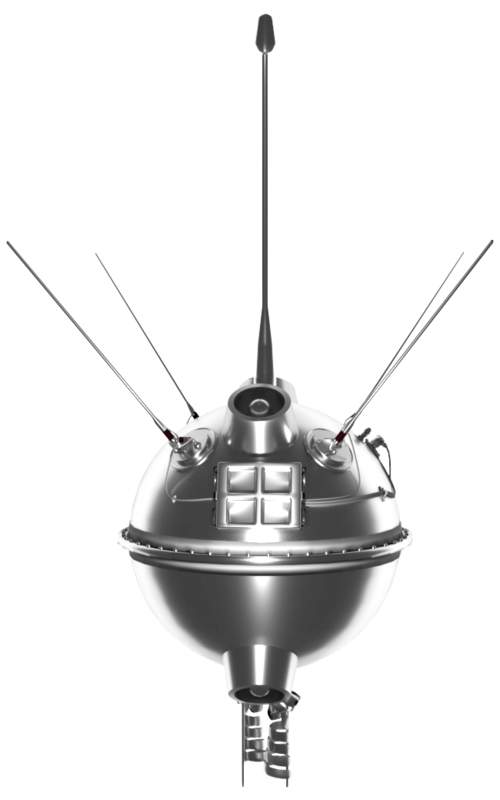
After the first probe missed
Early in 1959 the Soviet rocket subsequently named Luna 1 passed its target and entered orbit around the Sun. That was an important achievement, but the intended impact had not occurred. The effort also followed failed launches in 1958 and another failure in June 1959. The September flight therefore continued a specific engineering task: accelerate a probe beyond Earth's grasp and aim it where the moving Moon would be several days later. The mission's familiar name was assigned after the events themselves.
September 12 and a glowing cloud
On September 12, 1959 the next probe left Earth on a lunar interception trajectory. Its spherical body and projecting antennas resembled those of its predecessor. Instruments investigated particles, micrometeoroids and the magnetic environment. The upper stage released sodium, producing an artificial luminous cloud that observers on Earth could follow optically. This unusual light belonged to a known tracking experiment. It was neither a photograph of a spacecraft on the surface nor evidence for a substantial lunar atmosphere, and should not be described as either.
An impact rather than a landing
The probe reached the surface on the evening of September 13 in Universal Time. In Moscow it was already September 14, accounting for some differences in popular anniversary dates. LPI lists an impact region between Mare Imbrium and Mare Serenitatis, approximately along the prime meridian. The probe had no landing engine designed to preserve it. Its transmission was expected to cease when its body was destroyed. Agreement between the predicted journey and radio tracking is central to the success claim: panoramas or subsequent communications were never expected from this mission.
What the instruments established
Measurements approaching the target found neither a strong global lunar magnetic field nor radiation belts comparable to Earth's. This negative result was informative: our neighboring world was not a miniature version of Earth's magnetic environment. It should not be expanded into a claim that the Moon has no localized magnetization, investigated much later by other instruments. The mission also carried metal spheres bearing Soviet emblems. These were symbolic cargo for an impact probe, not sample-return capsules. No detailed photograph records their final arrangement on the surface after the destructive collision.
The flight entered diplomatic history
A few days later, during his American visit, Nikita Khrushchev gave Dwight Eisenhower a replica commemorative sphere. NASA notes that this object is preserved at the Eisenhower Presidential Library and Museum. The technical operation thus acquired a separate material history on Earth: spacecraft development, tracking reports, scientific observations and a museum object each tell different parts of the story. Another Soviet success that year was Luna 3's photography of the far side. That involved another probe, another objective and another form of evidence; its images cannot illustrate a supposed Luna 2 landing.
Comparing the sources and conclusion
NASA's historical account explains the launch sequence, LPI supplies a mission catalog, and the inventory of artificial lunar objects distinguishes impactors from landers. Old catalogs differ in timing details and use approximate locations, so the globe marker is a regional guide. The larger evidential picture remains stable: a known launch sent a known probe toward the Moon, followed by the expected impact. The significance lies in turning calculation into contact with another world. Neither an invented soft landing nor a sighting of an unknown spacecraft is needed to make the achievement remarkable.


