A task beyond a successful landing
Luna 16 launched from Baikonur on September 12, 1970. The Soviet program was attempting something beyond an ordinary soft landing: deliver a small quantity of lunar material to laboratories on Earth without a person visiting the surface. Previous attempts had not completed that sequence; Luna 15 had ended with an impact. The new spacecraft combined a landing stage, a drill and a separate ascent stage carrying a return capsule. Success depended on the entire chain. Reaching the Moon intact would not by itself guarantee successful sampling or a safe journey home.
Orbit and a landing in darkness
The spacecraft entered lunar orbit on September 17. Subsequent trajectory changes prepared its descent, and on September 20 it landed softly in Mare Fecunditatis, near 0.68 degrees south and 56.30 degrees east. The Sun had already set: NASA emphasizes that sampling occurred in darkness. This makes the operation an interesting engineering achievement without making it mysterious. No driver needed to inspect the soil with human eyes. The procedure depended on mechanisms, sensors, commands and a stable platform built to operate under conditions anticipated by the mission designers.
The drill and capsule
After landing, an automatic drill penetrated approximately thirty-five centimeters into the surface regolith. The sample was fragmented material accumulated above the lunar mare's basaltic foundation, rather than a large intact rock selected by an astronaut. The mechanism transferred the collected soil into a small spherical capsule mounted on the ascent section. Institutional references generally give the returned material's mass as about 101 grams. Some older historical summaries contain different rounding or errors in depth units. These call for cross-checking the references, rather than inventing different versions of the mission itself.
The return journey
On September 21 the upper stage launched, leaving the landing platform behind. It traveled directly toward Earth without a rendezvous with a crewed spacecraft in lunar orbit. On September 24 the capsule entered the atmosphere and descended by parachute in Kazakhstan. The technical achievement now became a specimen available for study. Luna 16 was the first robotic spacecraft to return lunar soil, but it was not the first delivery of lunar material by any means. Apollo 11 and Apollo 12 astronauts had already returned samples. Keeping those two kinds of first separate preserves the actual achievement.
What the material revealed
Researchers examined mineral grains, glass and fragments recording impact processing. Bevan French's study, preserved in NASA's technical repository, investigates shock-metamorphic features in the Mare Fecunditatis sample and compares them with Apollo material. The significance is that the mission left more than a statement of flight success: physical material supported repeatable laboratory observations. It helps establish how meteorite impacts fragmented and transformed the lunar surface. A single small core nevertheless cannot describe the geology of the entire Moon. Its scientific value comes from a known locality and specific mineral evidence, rather than unlimited geographical coverage.
Comparing the sources
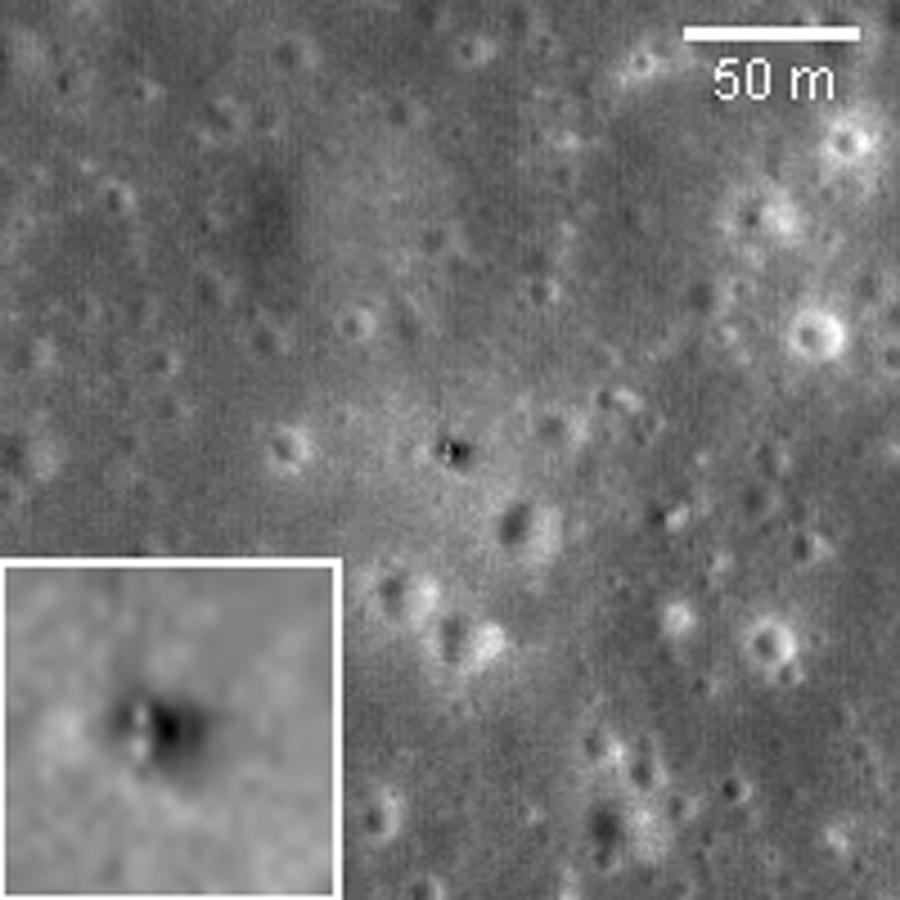
LPI catalogs connect the launch, landing and return. NASA publishes an orbital image of the remaining station, while a scientific paper studies the returned material itself. These different results strengthen the mission history because the trajectory, spacecraft remnant and laboratory sample answer different questions. Discrepancies in old reference figures for mass or units do not overturn the documented operation; the consistently supported values are approximately 101 grams and thirty-five centimeters. This is an example of human-built automated machinery operating on another celestial body. It requires neither a mysterious capsule nor an unknown origin to explain its significance.


