A pulse waits in an archive
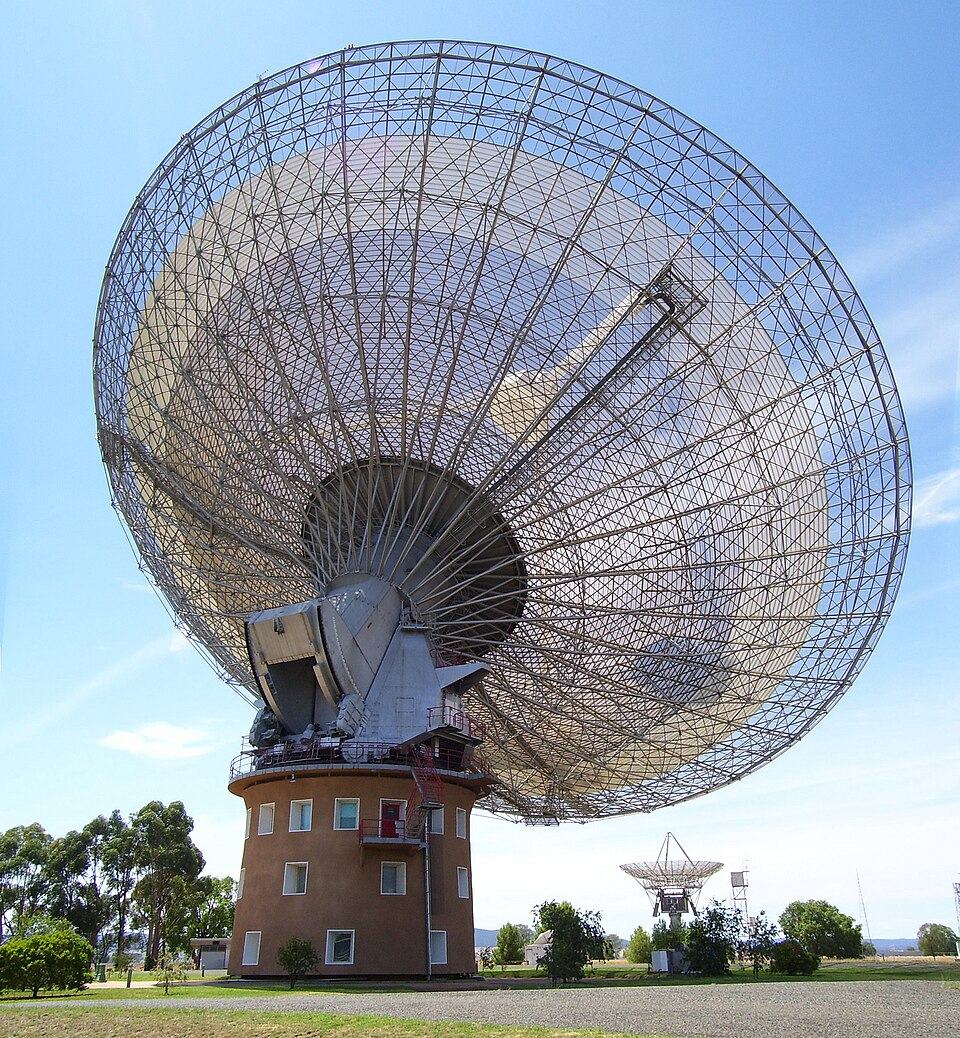
On July 24, 2001 Australia's Parkes radio telescope recorded a short signal during a survey of the Magellanic Clouds region. It did not immediately become the announced discovery of a new phenomenon. Years later Duncan Lorimer assigned student David Narkevic to search preserved data for unusual single pulses. In 2007 the team recognized an exceptional burst. The event consequently has two important dates: the radio waves were received in 2001, while recognition and scientific publication occurred in 2007. Combining them moves the observational history by six years.
Extremely bright and extremely brief
Lorimer and colleagues' original paper described a burst of approximately thirty janskys lasting less than five milliseconds. That interval is too short for ordinary human perception, so the event existed in instrumental records rather than as a visible flash in the sky. Particularly important was the frequency-dependent arrival pattern. Passage through free electrons delayed lower radio frequencies more strongly. This dispersion supplied information about material along the line of sight. It did not directly provide a photograph of the source, a unique distance or an identified host galaxy.
Why the team considered a distant source
The measured dispersion substantially exceeded the Galactic contribution expected by the authors for that direction. They inferred a source much farther away and probably unrelated to the Small Magellanic Cloud near the telescope's pointing. This was an inference from measurements and an electron-content model, rather than discovery of a host galaxy. Parkes did not localize the single burst precisely enough to identify a particular object. Angular proximity to a familiar galaxy therefore cannot establish origin in that galaxy, and the celestial direction cannot be converted into a location on an Earth map.
No repeat arrives on schedule
The researchers reported that about ninety hours of additional observations revealed no further bursts. Their paper considered catastrophic origins, including explosive events and mergers of compact objects. These were suggestions rather than measurements of a distant star's destruction. Failure to observe a repeat within a limited window does not prove that the source will never emit again. It describes the sensitivity and duration of that search. Later discovery of repeating fast radio bursts makes particularly clear why an early interpretation of one event cannot be extended automatically to an entire future population.
From an isolated anomaly to a class
CSIRO's historical overview explains that the remarkable brightness initially attracted skepticism. Other fast radio bursts and precise interferometric localizations of some sources subsequently changed the context. Those developments strengthened the general extragalactic interpretation without retrospectively identifying the first burst's exact galaxy. A later analysis of the same archives explicitly confirms recovery of the original pulse in the observation of July 24, 2001. The archive became an active scientific instrument: new questions and methods extracted events that were not the principal goal of the original survey and might otherwise have remained unnoticed.
Comparing dates and conclusions
The original article establishes burst properties and initial interpretations, CSIRO describes the field's development, and reanalysis connects the story to a specific archival date. These sources agree that an unusual short radio signal existed, while reflecting different amounts of later knowledge. The review status leaves this event's particular engine unresolved without questioning the record itself. There is no basis here for introducing an intelligent sender: an unidentified astrophysical mechanism is not equivalent to a message. A reliable account preserves the pulse, its analysis and the subsequent growth of the science as related but distinct stages.


