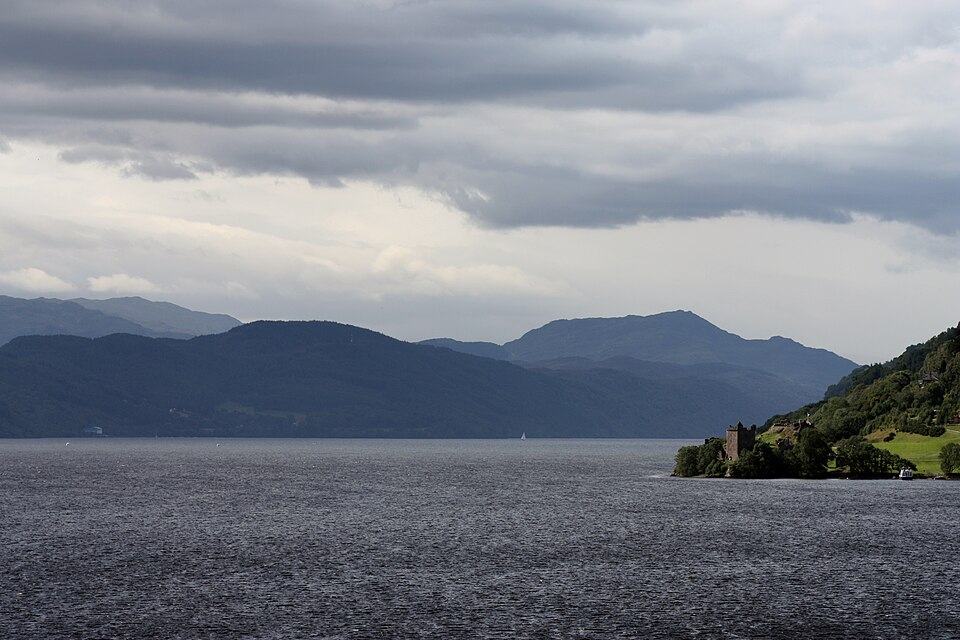
The loch, the legend and a testable question
Nessie is the name given to a supposed inhabitant of Scotland’s Loch Ness. Accounts describe dark humps, a long neck, disturbances on the water and occasionally something on land. Those descriptions need not share a single cause: calling them a “monster” groups different observations before they have been examined. This article therefore separates the legend’s history, individual records and investigation results. Our map marker identifies the loch’s general area, rather than a verified location of an unknown animal.
AD 565: a story, not an established encounter
The oldest story commonly associated with Nessie is assigned to AD 565: Saint Columba supposedly stopped a water beast from attacking. It survives in his life written by Adomnán after the events it describes. This is a religious account of a miracle, rather than a zoological observation report. The year cannot be treated as the confirmed first discovery of a surviving unknown species. The historical sightings register helps trace the story’s transmission, but reproducing an old account does not create a new independent witness.
1933: the modern Nessie takes shape
Modern publicity began with Aldie Mackay’s account of unusual movement by a large object on the water. The Inverness Courier published the story on 2 May 1933. The publication date should be distinguished from the alleged encounter: brief historical summaries do not all date that episode identically. Road improvements opened views of the loch, while newspaper attention brought more observers.
Further reports included a long-necked creature crossing a road and additional photographs. Their diversity became a difficulty: a many-humped serpent and a long-necked animal call for different explanations. Public interest increases the number of observers, but also spreads a familiar image against which people may interpret an indistinct outline.
1934: the famous photograph and fabricated evidence
The so-called surgeon’s photograph, published in 1934 and associated with Robert Kenneth Wilson, shaped Nessie’s most recognisable silhouette. The Science Museum Group’s collection record explicitly describes it as a subsequently exposed hoax. It should not be presented as an authentic portrait of an unknown animal, however often it appears in books or on souvenirs.
Another early lesson involved purported monster tracks that specialists attributed to a hippopotamus foot. Fabrications make provenance checks essential. Discovering one hoax does not, however, identify the cause of every other wave, photograph or eyewitness account. Each record still requires its own examination.
1987: what Operation Deepscan measured
In October 1987 Adrian Shine’s expedition used twenty echo-sounder-equipped vessels to form a line across the loch. Interesting acoustic contacts were revisited. The Loch Ness Project’s account says most were stationary, while three had disappeared on follow-up and remained unexplained.
An acoustic contact measures a reflected signal; it is not a photograph of an animal. Uncertainty about those targets does not establish a plesiosaur. Repeatability, original records, equipment characteristics and an independent identification method would be needed. The expedition is valuable because its methods can be examined, rather than because it promises a final answer.
2018–2019: environmental DNA and the eel proposal
A University of Otago team analysed 250 water samples and announced findings on 5 September 2019. The analysis did not support a large-reptile explanation, while eel DNA was widespread. Researchers discussed a large eel as a possible explanation for some reports. But their analysis did not measure fish size: finding eels and discovering a giant eel are different conclusions. Sampling and DNA detectability constrain this kind of survey, so its findings should be read alongside its methodological qualifications.
2025: genuine discoveries during the searches
The National Oceanography Centre reported finding an underwater camera trap believed to have been installed in 1970. It was recovered from roughly 180 metres down; the surviving film did not show Nessie. During separate searches in May 2025, organisers released underwater footage of pike and reported rediscovering old research cabling. These are useful discoveries about the loch and its exploration. Fish being present does not establish that a hypothetical predator exists to eat them.
When was Nessie last “seen”?
When checked on 7 November 2026, the newest entry in the available Sightings Register section was dated 21 August 2026. A witness described a dark object remaining at the surface for around twenty seconds. Its reported size and distance were observer estimates, rather than instrument measurements. This is the latest report on the page checked, not a verified encounter or a guarantee that nobody has made a newer claim elsewhere.
How to compare the evidence
A useful new submission includes the original file, continuous footage before and after the event, camera direction and visible landmarks. Together these can help separate object motion from waves, a vessel’s wake or a changing viewpoint. Independent recordings from two positions are especially valuable: the same account republished several times remains one source. An open investigation should allow both an ordinary explanation and a temporary finding of insufficient evidence, without turning uncertainty into a claim that a new species has been discovered.


