Investigating ground without sunlight
LCROSS launched with the Lunar Reconnaissance Orbiter on June 18, 2009. Its assignment was unusual: investigate material that receives almost no sunlight by deliberately creating an impact. The team selected a permanently shadowed part of Cabeus crater near the south pole. Cold polar traps could preserve volatile substances, but remote indications needed testing. Instead of landing and drilling, the mission would lift ground material into illuminated space. Instruments could then examine its spectral composition and behavior after collision, turning an otherwise inaccessible patch into a temporarily observable sample.
A rocket stage becomes the impactor
The spent Centaur stage remained part of the flight system until final separation. The shepherding spacecraft carried cameras, spectrometers and other instruments to observe the impact's consequences. NASA's history describes an August sensor problem that consumed propellant and sharply reduced the maneuvering margin. The team nevertheless preserved the principal experiment. This intermediate difficulty helps explain the achievement: striking the selected shadow required control of a long trajectory. It was not simply a matter of releasing an object into free fall immediately after launch from Earth and waiting for it to arrive.
Four minutes between two impacts
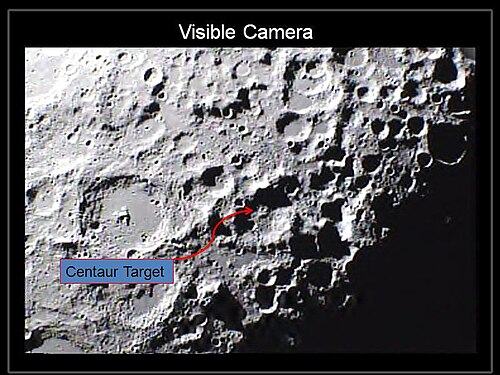
On October 9 Centaur struck the surface around 11:31 Universal Time, ejecting dust, fragments and vapor. LCROSS watched the developing plume and transmitted observations until its own impact about four minutes later. The history therefore contains two impact locations and two separate vehicle masses. The map marks the post-mission estimate for Centaur, approximately 84.6796 degrees south and 48.7093 degrees west. The localization paper also provides uncertainty. A long string of decimal places should not conceal that uncertainty or suggest that the observing spacecraft hit the identical spot.
What the spectra were testing
Anthony Colaprete's team examined ultraviolet, visible and near-infrared measurements. Their Science paper reported water in the ejecta. The result did not depend on how spectacular the event appeared to someone watching from Earth: chemical information lay in the measured variation of radiation with wavelength. A separate paper examined the cratering experiment and plume behavior. Considering impact physics alongside the spectra helped connect the detected signals to material excavated from the selected cold lunar region, rather than treating every brightness change as an independent chemical identification or relying on visual spectacle alone.
Percentages with their uncertainty
The scientific paper estimated a water-ice mass fraction of approximately 5.6 percent with an uncertainty of 2.9 percentage points in the observed material. That does not measure an identical concentration throughout the crater, much less throughout the Moon. The estimate depends on how much excavated regolith reached sunlight and became observable. NASA announced water publicly in November 2009, with detailed papers appearing in 2010. Analytical chronology must be separated from the event date: the material was excavated on October 9 even though its composition was described more fully afterward.
Comparing measurements and history
The mission chronology establishes flight events, the scientific papers establish the spectral result and its limitations, and the localization study identifies the experiment's location. PDS preserves documentation for independent observations from Earth. These sources distinguish a real measurement from the popular image of an underground lake. LCROSS did not discover an exposed body of water or map every polar deposit. It demonstrated water in material from one shadowed locality. That bounded but testable conclusion makes the experiment strong evidence and a useful starting point for further investigation of the distribution of lunar volatiles.


