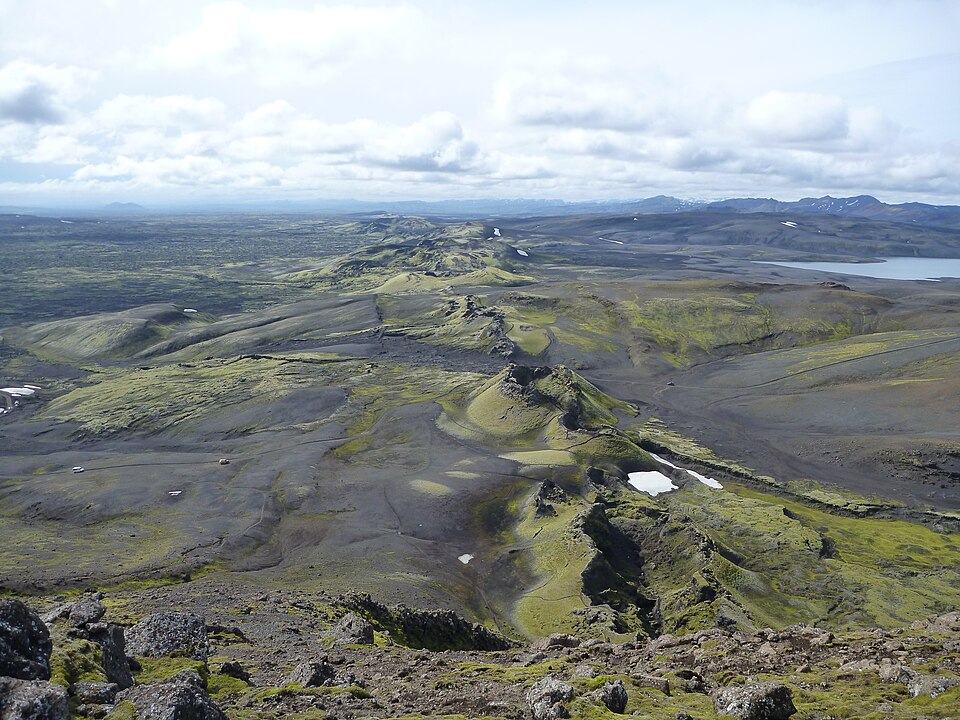
8 June 1783: a prolonged eruption begins
Laki differs from the familiar image of one volcanic explosion. On 8 June 1783 a sequence of eruptions began along an extended fissure system in southern Iceland; activity continued until February 1784. Smithsonian treats Laki as part of the Grímsvötn volcanic system. Our marker identifies the approximate fissure area, rather than a centre for every later atmospheric observation. The dates matter: summer haze and continuing eruptive activity belong to the same history, but not to one brief episode.
Why observers called it a dry fog
European accounts described a persistent, unusual haze that ordinary moist fog could not fully explain. Volcanic emissions included sulfur gases from which fine particles formed. These changed atmospheric transparency and the Sun’s appearance, while winds carried pollution far from its source. An unusual colour is therefore not independent evidence of an unknown object in the sky: the observer sees light passing through an altered atmosphere. The word “fog” in an old diary does not, by itself, identify the air’s chemical composition.
What the historical record preserves
Researchers have compared weather logs, letters and other documents from different locations. Thordarson and Self’s study demonstrates the value of a sequence of haze-onset dates, rather than a single dramatic narrative. Such comparisons require attention to copying errors and local conditions. Two writers repeating one newspaper item do not become two independent instruments. Regular observations by one person are especially valuable because they can reveal an event’s beginning, interruptions and disappearance. A detailed chronology can be more informative than an isolated colourful description.
Testing the atmospheric explanation
Modern modelling examines the conversion of gases into aerosols, their transport and their removal from the air. A model must reconcile the eruption’s location, the duration of emissions and the pattern of effects. That is a stronger test than coincident dates: an explanation should predict where pollution travels under particular weather conditions. Reconstructing the event nevertheless does not create direct eighteenth-century measurements. Results depend on estimated emissions, the circulation represented in the calculation and the model’s own design.
Why Laki should not explain everything at once
The eruption brought severe consequences, but attributing a particular death, crop failure or cold season is a separate research problem. Pollution, weather, farming conditions and food availability could act together. “After the eruption” is not a calculation of causal contribution. We therefore do not import popular precise Europe-wide death totals into this record or declare every subsequent climate anomaly a direct effect of Laki. The distinction is between a well-supported haze mechanism and the more complicated attribution of historical outcomes.
What can be examined today
The lava fields and crater chain survive as a geological record; the national park explains their origin along the Laki visitor trail. The present landscape, however, is not a photograph of the 1783 haze. A full examination needs different kinds of evidence: field descriptions, dated accounts and a physical reconstruction of the atmosphere. Their agreement makes this case instructive. A vast and initially frightening phenomenon can have a natural explanation while its quantitative details remain open to revision.


