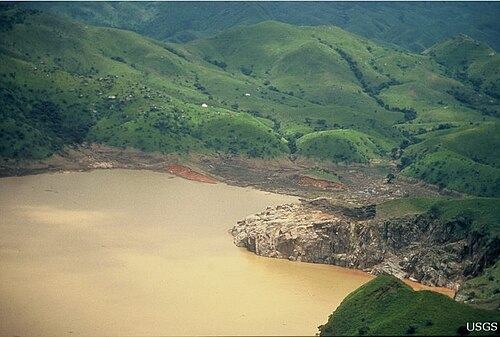
A disaster without a familiar fire
On the evening of 21 August 1986 settlements near Lake Nyos in Cameroon lay in the path of a gas cloud. More than 1,700 people and many domestic animals died. The scene did not resemble a conventional eruption with lava flows or a major fire. Lethal effects had followed low ground, leaving investigators to determine what had happened. Survivors' accounts helped reconstruct the sequence, but unusual sensations could not simply be treated as chemical measurements. Researchers compared testimony with geology, water samples, environmental observations and medical evidence. Whether the event could recur depended on understanding its physical cause.
Deep water stored carbon dioxide
Nyos lies in a volcanic region. Carbon dioxide entered from deep sources and dissolved in the lower water column. Pressure allows water at depth to retain quantities of gas that would escape near the surface. Where layers remain separated, accumulation can continue even while the lake looks calm from above. The Science investigation attributed most of the released gas to carbon dioxide previously stored in deep lake water. Chemical and isotopic evidence supported a magmatic source. That source did not require a direct eruption of fresh magma on the night of the disaster, an important distinction between where the gas originated and how it escaped.
How a cloud emerged from the lake
When gas-rich water rises and pressure decreases, bubbles form. Those bubbles can help bring up more water, reinforcing the release. The resulting cloud then follows the terrain: cold carbon dioxide is denser than ambient air and can accumulate in low places. The danger consequently did not spread as a uniform circle around the shore. The USGS investigation discussed rapid loss of consciousness and the absence of persuasive evidence for burning by hot volcanic gases. Reports of suffocation and unfamiliar smells therefore required investigation, rather than automatically justifying the familiar model of a fiery volcanic eruption.
A mechanism does not identify every initiating detail
The exact disturbance that first brought gas-rich water upwards proved harder to establish than the cloud's composition. The early USGS report explicitly left the trigger unresolved. Presenting a particular landslide or other single disturbance as conclusively established would therefore overstate the evidence. Meanwhile, measurements after the disaster showed that gas could accumulate again. A related tragedy had already occurred at Lake Monoun in 1984. Nyos transformed a rare and poorly recognised hazard into a subject for continuing measurement. Researchers needed not only to explain the past, but also to reduce the amount of gas remaining dissolved in the lakes.
From investigation to controlled degassing
Pipes were subsequently installed to lift deep water and release its gas in a controlled process. A 2005 study evaluated degassing results alongside continuing carbon dioxide recharge. These observations support the physical reconstruction independently of the earliest rumours. Comparing the sources reveals a strong explanation for the principal mechanism and a narrower uncertainty about its initiation. The archive treats Nyos as a real natural disaster whose unusual character requires no supernatural cause. Understanding the mechanism does not diminish the tragedy: it explains how an apparently quiet landscape concealed an accumulated hazard and why sustained monitoring became essential.


