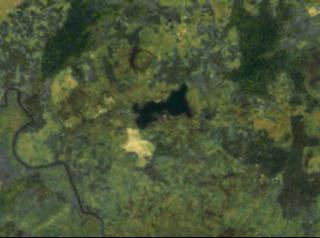
A cloud before dawn
During the night of 15–16 August 1984, thirty-seven people died near Lake Monoun in Cameroon. Early reports described an explosion, a water wave and a white cloud resembling ordinary fog. Passing through that cloud proved fatal. The Smithsonian volcanism bulletin preserved preliminary descriptions of damaged vegetation, a wave roughly five meters high, vomiting, paralysis and rapid deaths. Those observations arrived before chemical investigations were complete, so the language of the first account still reflected uncertainty. Scientific papers generally date the event to 15 August, while the early bulletin placed the conspicuous disturbance before dawn on the following day.
The lake after the disaster
Cameroon’s government sent investigators who collected rocks and damaged vegetation. According to the initial bulletin, residents fled but many soon returned, and the water remained reddish toward the end of August. Monoun occupies a volcanic crater, but that setting does not establish a conventional lava eruption at the moment people died. Investigators needed to distinguish possible gas sources and ways gas could reach the surface. The scene suggested several hazards at once: an explosion, poisoning and moving water. An explanation had to address their relationship instead of using the word volcanic as a complete answer to every question.
Deep water stores gas under pressure
Haraldur Sigurdsson and colleagues described a crater reaching approximately ninety-six meters and oxygen-free water below fifty meters. When deep samples were raised and depressurized, gas escaped, consisting predominantly of carbon dioxide. This demonstrated a reservoir that the lake’s ordinary surface appearance could not reveal. Carbon dioxide is denser than air and can accumulate in depressions, displacing breathable atmosphere. People could therefore enter a lethal environment without a fire or an obvious plume of toxic smoke. The proposed mechanism connected the chemistry of deep lake water with the topographic setting of deaths around the lake.
Why this was not a conventional volcanic blast
In a subsequent paper Sigurdsson emphasized the absence of expected indications of hot magmatic gases, including conspicuous sulfur compounds. Isotopic and chemical observations supported prolonged input and accumulation of deep carbon dioxide rather than a sudden direct injection of hot volcanic gas. Suggested triggers included a landslide and disturbance of the lake’s stable stratification; the early study also considered an earthquake. Confidence in the principal gas mechanism does not require equal certainty about every initiating detail. Bubble formation as pressure decreases can reinforce water ascent, allowing a localized disturbance to develop into a substantial surface release.
What changed in understanding the hazard
Monoun was a separate disaster preceding the much better-known Lake Nyos event. Papers introducing the natural hazard discuss both, but the date and death toll in this entry concern Monoun alone. Early reports establish human consequences and shoreline conditions, while water analyses supply a physical explanation for the gas. Uncertainty over the precise initial disturbance does not negate the agreement between this chemistry and asphyxiation. The explained classification concerns a limnic gas release, rather than a claim that every minute of the night has been reconstructed. The case reveals the danger of gradual accumulation beneath a lake that can look quiet from shore.


