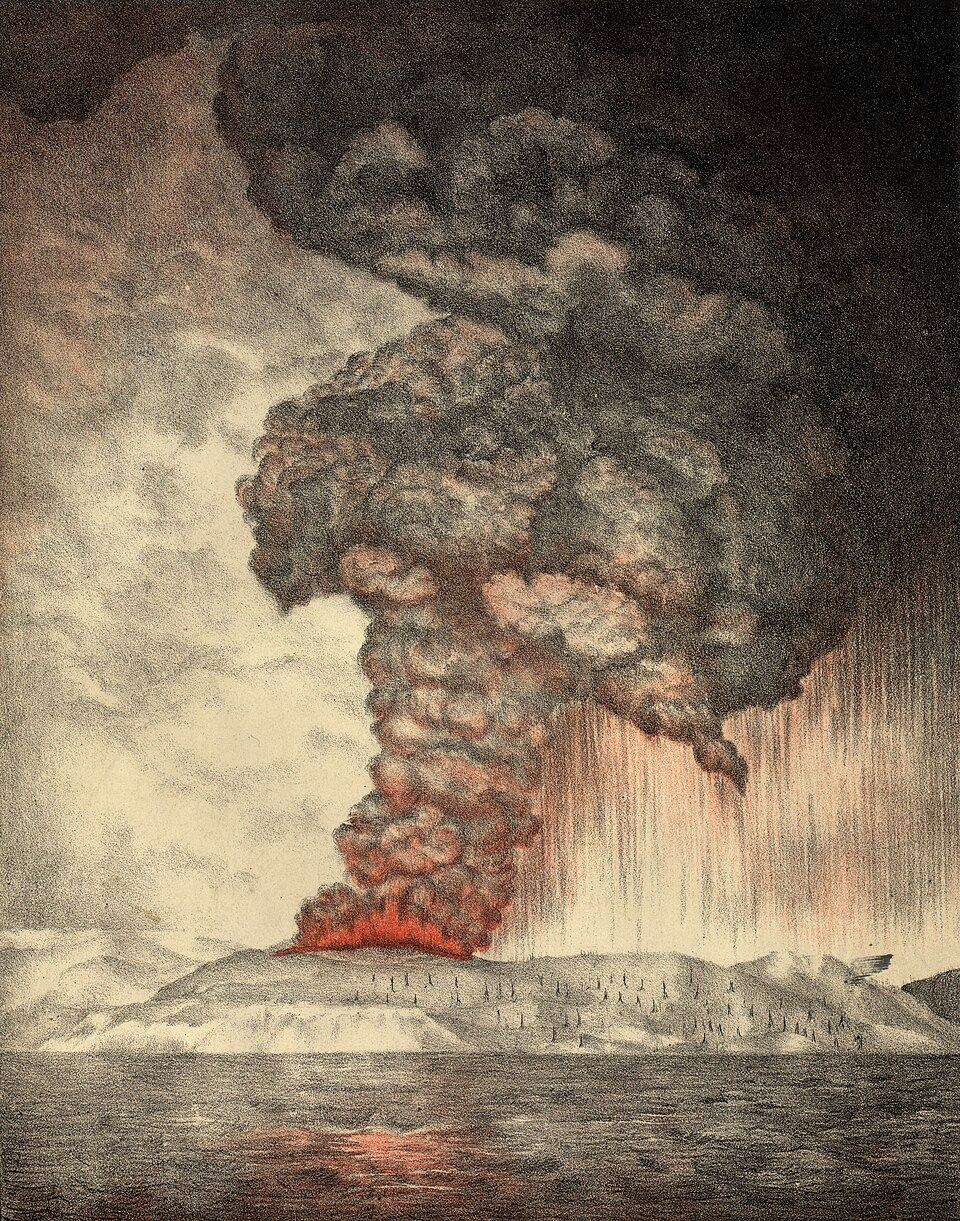
26–27 August: the climax, not the whole beginning
Krakatau’s activity was being discussed well before the catastrophic phase at the end of August 1883. NOAA describes ash, explosions and floating pumice observed in preceding months. We therefore use 27 August to anchor the climax, rather than to imply a sudden beginning without warning. The marker identifies the volcanic area in the Sunda Strait. It is not the exact location of every tsunami impact, heard explosion or unusual sunset described far from Indonesia.
What changed on the island itself
Smithsonian associates destruction of much of the former volcanic island with caldera collapse. That is a physical change in geography, rather than only an eyewitness narrative. Today’s Anak Krakatau outline cannot simply be projected onto the pre-1883 landscape: later volcanic activity produced new landforms. Reading an old document requires knowing which islands and summits existed when it was written. A modern shoreline map is useful context, but not a complete reconstruction of the earlier terrain.
Water and air preserve different traces
Tsunamis, loud sound and later sky effects were linked to the eruption, but they were not one signal travelling in the same way. An ocean wave depends on water displacement and seafloor geometry; an atmospheric disturbance depends on the properties of air. Reports must be compared with their times, distances and recording methods in mind. An explosion’s strength alone does not explain wave height at a particular coast. A catalogue of observations is therefore more useful than a single sensational claim about the “loudest sound”.
How exceptional sunsets became a shared archive
The Royal Society describes the collection of letters, drawings and reports about atmospheric effects. People in different places observed prolonged afterglows and unfamiliar twilight colours. Those materials matter as dated observations with traceable provenance, rather than exact colour photographs. Paper, artistic technique and memory all influence an image. Comparing many records helps distinguish a persistent phenomenon from one drawing’s peculiarities, but cannot remove every limitation of historical evidence. The method gives these pictures scientific value without treating them as modern instruments.
Why a green tint could appear in the sky
A 2024 study tested which volcanic-aerosol properties allow twilight calculations to reproduce green colours reported by witnesses. The important factors include particle size, its distribution and the layer’s optical thickness, rather than dust simply being present. This is an explanation through light scattering, not proof that every unusual sunset had the same composition. The model demonstrates a physically possible mechanism and its constraints. It does not turn a nineteenth-century sketch into an air sample collected by a modern sensor.
Reading the sources together
This case connects three scales: changes to a volcano, a regional disaster and distant atmospheric observations. Each evidence set has its own dates and uncertainties. Combining them without distinctions can confuse a prolonged consequence with the instant of the explosion. The more productive question is whether independent kinds of evidence agree with an expected mechanism. Krakatau shows how an extraordinary sky can become a subject of testable investigation, requiring neither dismissal of witnesses nor a supernatural explanation.


