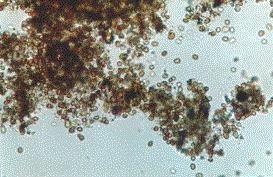
Water collected in household vessels
On the morning of 25 July 2001 residents of Changanassery in Kerala noticed reddish precipitation. Many households collected rainwater in containers, so the unusual event left samples that could be tested. Researchers’ Eos account describes the initially studied shower as affecting a small part of the town at about 8:30 a.m. Reports of colored rainfall subsequently arrived from other districts over several months. A November report by the Centre for Earth Science Studies and Tropical Botanic Garden and Research Institute describes how a resident’s notification led to visits, water collection and interviews with neighbors.
The first explanation changes
Material gradually settled to the bottom of containers, leaving nearly colorless water above it. Suspended particles were therefore responsible for the color, rather than a transformation of the water into a different liquid. Reports of an early-morning loud sound and flash initially suggested meteoric material to investigators. That preliminary idea was not their final result. Chemical study and microscopy directed attention toward tiny round structures resembling spores. Retelling this sequence carelessly can preserve the first suggestion as the scientific conclusion while omitting the analysis that led the authors to change their working explanation.
Laboratories culture the material
Botanical specialists examined the samples. The report describes growth media and cultivation, after which the organism was assigned to the algal genus Trentepohlia. The short Eos publication also reports cultivation and that identification. This is positive evidence obtained from the substance, rather than a declaration that every mystery must necessarily be terrestrial. The phrase green alga does not require every visible mass of the organism to look bright green: pigments can produce orange or reddish appearances. Investigators could consequently connect the water’s color with biological particles without treating the popular expression blood rain as a literal chemical description.
Why an extraterrestrial proposal appeared
Godfrey Louis and Santhosh Kumar subsequently proposed a possible extraterrestrial origin and discussed a connection with a supposed meteor event. Their paper is an identifiable scientific claim that can be read and compared with other analyses; publication alone does not establish an origin in space. In 2015 Felix Bast and colleagues studied terrestrial Trentepohlia from an area associated with later red-rain reports and identified T. annulata using molecular methods. Their material came from tree bark, however. That study cannot be presented as direct sequencing of every particle in the 2001 rainfall. Differences in sampling year and sample provenance materially affect what an identification demonstrates.
What is explained and what remains open
For the examined 2001 water, direct cultivation and microscopy support terrestrial algal spores. The official report separately acknowledges that the mechanism placing so many particles into the air at once needed further investigation. Incompletely reconstructed transport neither cancels the material identification nor proves an arrival from space. Rainfall affected separate patches, and sample quality and examination depth varied between locations. The explained classification thus concerns primarily the color of the samples actually studied. Real unusual precipitation belongs in the history of laboratory investigation, while the assertion of extraterrestrial life remains an unverified interpretation requiring its own independent evidence.


