An ordinary flight became an extraordinary account
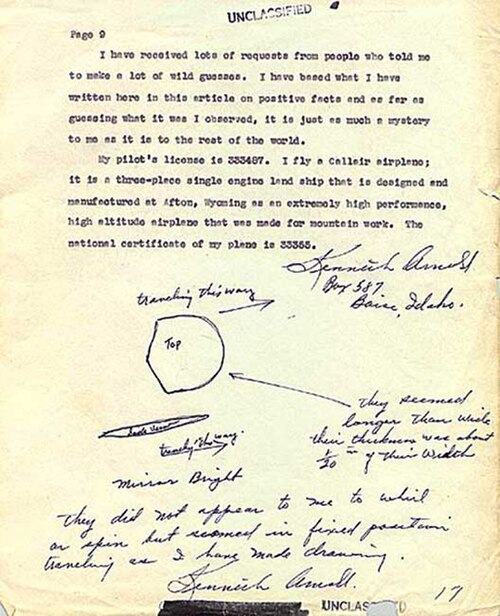
On June 24, 1947 Kenneth Arnold flew a small private aircraft across Washington State. In his written statement to military investigators, he explained that he was traveling from Chehalis to Yakima and had spent time searching for a missing transport aircraft near Mount Rainier. This background matters because his attention was already directed toward the mountain slopes and surrounding airspace. He described clear weather and smooth flying. A brilliant flash then made him suspect another aircraft was nearby and prompted a more careful inspection of the sky.
A chain near the mountains
Arnold said he noticed nine shining objects traveling in a chain near the Cascades. He compared their positions with mountain landmarks and tried to time their passage between them. His description included oscillation, reflections and an unfamiliar manner of movement. He emphasized that he had not sought publicity and was reporting what he considered a real observation. Nevertheless, this was an account from a moving cockpit. Investigators did not obtain synchronized imagery with a measured scale that could independently establish the objects' sizes, ranges and three-dimensional route.
How an extraordinary speed was calculated
Arnold derived an enormous speed by relating apparent motion to an assumed distance near mountain landmarks. If the objects were at a different range, the same angular motion would correspond to a different linear velocity. This geometrical limitation is independent of a witness's honesty. Flying experience helps in describing one's aircraft and familiar aviation surroundings; it does not turn an unfamiliar distant patch into an object of known size. A number inferred from a visual assumption therefore cannot be presented as a radar measurement or proof of performance beyond all terrestrial technology.
Movement became a shape
Comparing the movement with a saucer skipping over water proved exceptionally memorable newspaper language. In public usage, 'flying saucer' soon became the name of a shape and an entire category of reports. The Smithsonian treats 1947 as a turning point: after Arnold's account, similar reports acquired a recognizable image and a large audience. The expression's development and identification of the original objects are separate questions. Even tracing every publication establishes how a story spread; it does not automatically provide a physical specimen of what the pilot saw.
A report in the postwar environment
The report appeared amid rapid advances in aviation, postwar secrecy and anxiety about renewed conflict. Military programs subsequently investigated unidentified sightings. The Blue Book archival guide describes this administrative history without making every early account a solved case. Arnold's written statement is valuable for its proximity to the event, while later surveys explain its public consequences. These records cannot be counted as independent observations of nine objects: they frequently repeat one underlying account, supplementing it with historical context and terminology that became familiar only later.
Comparing explanations and conclusion
Aircraft, birds, reflections and errors in estimating distance have been discussed, but the available data do not support one identification with secure instrumental confirmation. Our conclusion is limited but substantial: Arnold reported an unfamiliar spectacle, and the press transformed his description into an enduring cultural image. The observation's unresolved nature does not establish an extraterrestrial vehicle. Its cultural importance also does not require declaring its witness dishonest. The episode shows how a sincere but geometrically incomplete observation can have consequences much more definite than the physical interpretation of what was originally seen.


