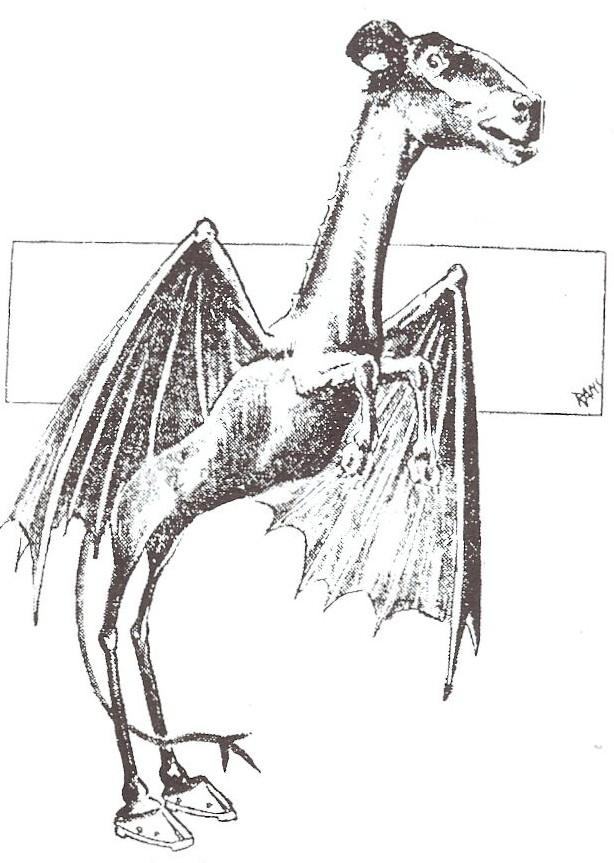
An older legend enters the newspapers
In January 1909 southern New Jersey and neighboring cities experienced a wave of reports about the Jersey Devil. Tradition associated the creature with the Pine Barrens and the Leeds family; later retellings supplied wings, hooves and an unusual head. A brief burst of newspaper attention helped transform a regional story into a widely discussed event. Atlantic County’s historical account describes thirty reported appearances within one week and stories spreading beyond New Jersey. That number concerns collected claims rather than thirty verified encounters with one animal. Reports of figures, noises and discovered footprints circulated together under the same familiar name.
Footprints take the leading role
The Cumberland County Historical Society reproduces reports from the Bridgeton Evening News. On 21 January the newspaper described tracks at Salem, supposedly turned outward and showing a difference between the right and left foot. An unfamiliar impression could give readers a sense of physical confirmation, although identifying its maker without a preserved measured sequence is difficult. Another item, dated 25 January, described an engineer startled by hissing near factory machinery. The resolution was escaping steam. Contemporary newspaper material therefore included stories in which ordinary causes explained a frightening impression, alongside claims of a threatening creature or mysterious footprints.
Public searches and a promised reward
Police, newspapers and curious residents became participants in the same expanding story. Atlantic County’s overview connects the wave with a ten-thousand-dollar reward offered by Philadelphia Zoo superintendent Robert Carson for capturing the creature. It also recounts proposals that the Devil might be a prehistoric animal, while noting the absence of a corresponding species in Academy of Natural Sciences records. Genre matters here: a historical summary of public discussion is not evidence that a scientific institution formally recognized a surviving pterosaur. Neither a substantial reward nor emphatic newspaper language produced an accepted zoological specimen establishing such an animal.
A monster becomes a performance
The county history separately describes a publicity fabrication at Philadelphia’s Arch Street Museum: a kangaroo received green painted stripes and artificial wings. This episode shows how entertainment entrepreneurs could exploit expectations that already existed among their audience. It does not establish that every report during the week was deliberately staged. New Jersey’s Pinelands Commission places the Devil in regional cultural history and preserves its legendary genealogy. A Camden historical compilation also illustrates how the stories returned to newspapers and became attached to local police figures. These layers have different dates and purposes and should not be collapsed into one continuous biological observation.
What survives the January wave
Newspaper extracts, regional historical accounts and an official description of the tradition survive, but there is no verified body of an unknown winged beast. Poorly documented tracks, an unexplained sound and a visual encounter offer different amounts of usable information. An established publicity fabrication explains its particular exhibit, without automatically explaining all Pine Barrens folklore. Suggestions involving cranes or other familiar animals remain possible interpretations of individual episodes. The best-established event is the January 1909 surge of public attention itself. This entry consequently treats the Jersey Devil as a documented legend and a collection of unverified reports, without recognizing a separate animal species from these materials.


