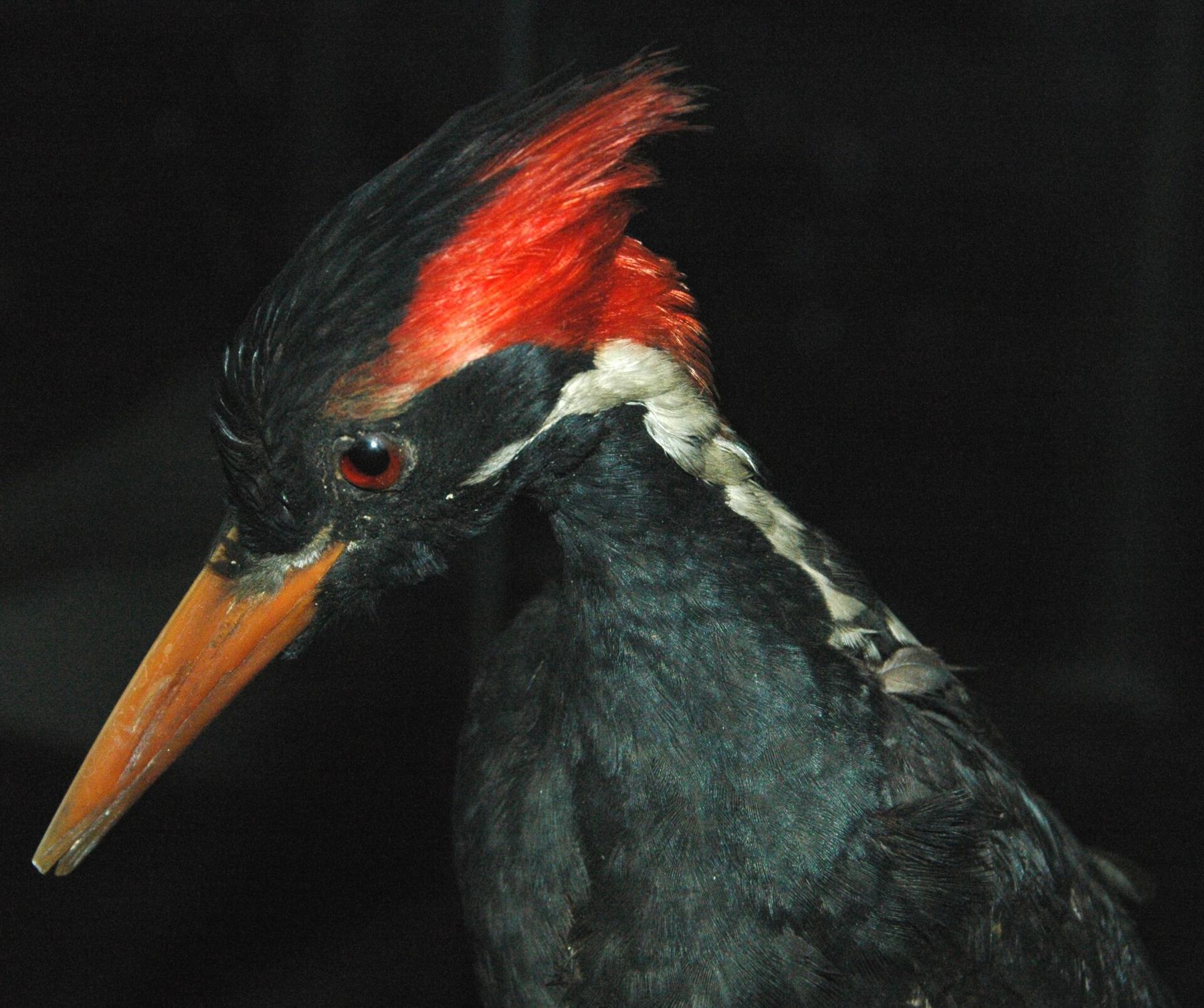
An encounter in flooded forest
Early in 2004 Gene Sparling reported an unusually large woodpecker encountered while kayaking in eastern Arkansas. The flooded forests of the Big Woods seemed a plausible refuge for the ivory-billed woodpecker, long absent from unequivocal records in the continental United States. His report attracted experienced observers and researchers associated with the Cornell Lab of Ornithology. Further brief encounters encouraged a substantial search rather than a single isolated anecdote.
In April that year David Luneau recorded a few seconds of a bird flying away from a boat. The short duration and limited image quality constrained analysis, but the sequence became the central physical argument. Investigators examined pale wing areas, apparent dimensions and flight behavior, comparing them with historical descriptions.
The scientific announcement
In 2005 a team led by John Fitzpatrick published a Science paper concluding that the species persisted in North America. The authors combined visual encounters during 2004 and 2005, the April video and acoustic indications. They interpreted the evidence as confirming at least one male. Publication therefore occurred in a different year from the pivotal filming, a distinction that matters in a chronological archive.
The announcement carried considerable conservation significance. Ivory-bills depended on mature forest with suitable timber, and habitat destruction was central to the history of their disappearance. Rediscovery would imply that surviving refuges retained more biodiversity than observers had assumed. The desirability of that result could not settle the identification of the bird, however, and the less encouraging alternative required close examination.
Why the interpretation was challenged
The principal alternative was a Pileated Woodpecker, a familiar species that can expose extensive pale areas during particular wing positions. Critics disputed interpretations of individual frames and apparent proportions. A University of Florida review explains the difficulty of identifying the missing species from brief views, uncertain sounds and low-resolution imagery. Even a sound resembling its characteristic double knock requires investigation of alternative sources.
Cornell and its partners subsequently conducted intensive searches across several states. Their retrospective account describes more than half a million acres examined during 2006–2010. Those efforts did not produce a generally accepted sequence of new images, an accessible nest or a breeding population available for repeated observation. Later claims from other locations cannot be attached to the Arkansas point as continuations of one established encounter. They have separate dates and verification problems.
Comparing status with evidence
Federal conservation listing and biological confirmation answer different questions. The checked USFWS species page records the bird's protection history; administrative discussion of delisting does not turn disputed footage into an unequivocal identification. The Arkansas case is stronger than an anonymous rumor because it has named observers, a scientific publication and public technical criticism. It is weaker than a rediscovery supported by indisputable photographs or a specimen. A review status preserves the difference between a compelling possibility, a published argument and a confirmed surviving population, without presenting modern survival as an established fact.


