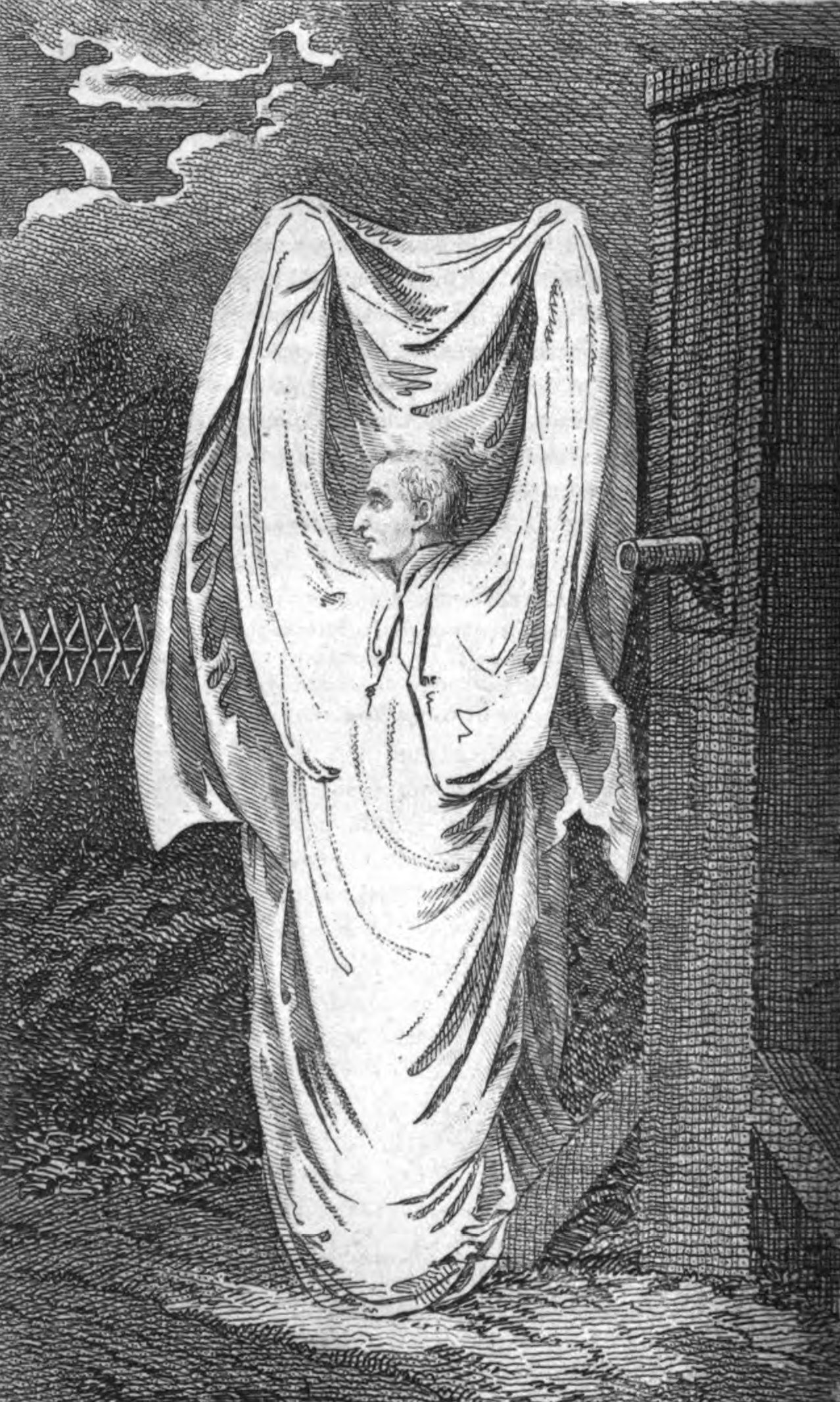
A white figure in dark lanes
During 1803, reports of a figure near the churchyard and local paths frightened people in Hammersmith. Descriptions differed: the supposed ghost might resemble a person in a white covering or a more elaborately disguised creature. Those differences should not be smoothed away merely to produce a memorable legend. Several accounts from the same area do not establish one perpetrator, much less one supernatural being. Night patrols formed against this background. Francis Smith, an excise officer, joined the effort to identify the source of local fear.
The encounter on 3 January 1804
That evening, Smith encountered Thomas Millwood in pale work clothing. He mistook the man for the figure he was seeking and fired. Millwood was a bricklayer, not an apparition that had finally been discovered. The court case and investigation offer firmer evidence for this encounter than the earlier stories of appearances. We use the fatal shooting’s date as the exact date of this record, with 1803 entered separately for the documented wave of reports. This does not imply that every account during those years has a known day, or that Millwood was responsible for earlier rumours.
What the court examined
The Old Bailey record concerns the murder charge against Smith, testimony and the court’s decision. The London Archives explains that the jury initially sought a manslaughter verdict, which the judges would not accept. A murder verdict and death sentence followed, with the punishment subsequently reduced. The case attracts attention because of the unusual mistaken identification, but its legal implications should not be transferred directly to current law. For this atlas, a narrower point matters: an observer’s sincere fear and mistaken identification can have real consequences without establishing the existence of what the observer feared.
The man who called himself the ghost
Historical accounts name shoemaker John Graham, who admitted dressing as a ghost to frighten people after his children had been frightened by ghost stories. This supplies an important ordinary explanation for part of the affair. It is not a reason to assign every local encounter to him automatically. Orleans House Gallery holds a print titled John Graham, the Hammersmith Ghost, while London Picture Archive catalogues an engraving executed in 1804. Such objects matter as traces of the story’s fame. They establish that it became an image and an object of public memory, rather than providing a photograph of an otherworldly being.
Reading the story without creating another myth
The strongest part of the record concerns the death of an identifiable person and the documented proceedings. Earlier encounters need individual assessment: who saw a figure, under what light, at what distance, and with what opportunity for an ordinary disguise? Modern retellings often join the material into a seamless narrative and lose the difference between testimony and an author’s connecting assumptions. We retain that distinction. The marker locates the Black Lion Lane area associated with the history, rather than identifying a private home as a present haunting. Exposing one human imitation does not supply a universal explanation for all ghost stories. Equally, an incomplete reconstruction of the remaining rumours does not make those rumours supernatural facts. A compelling historical account can acknowledge both limits without losing the significance of the tragedy.


