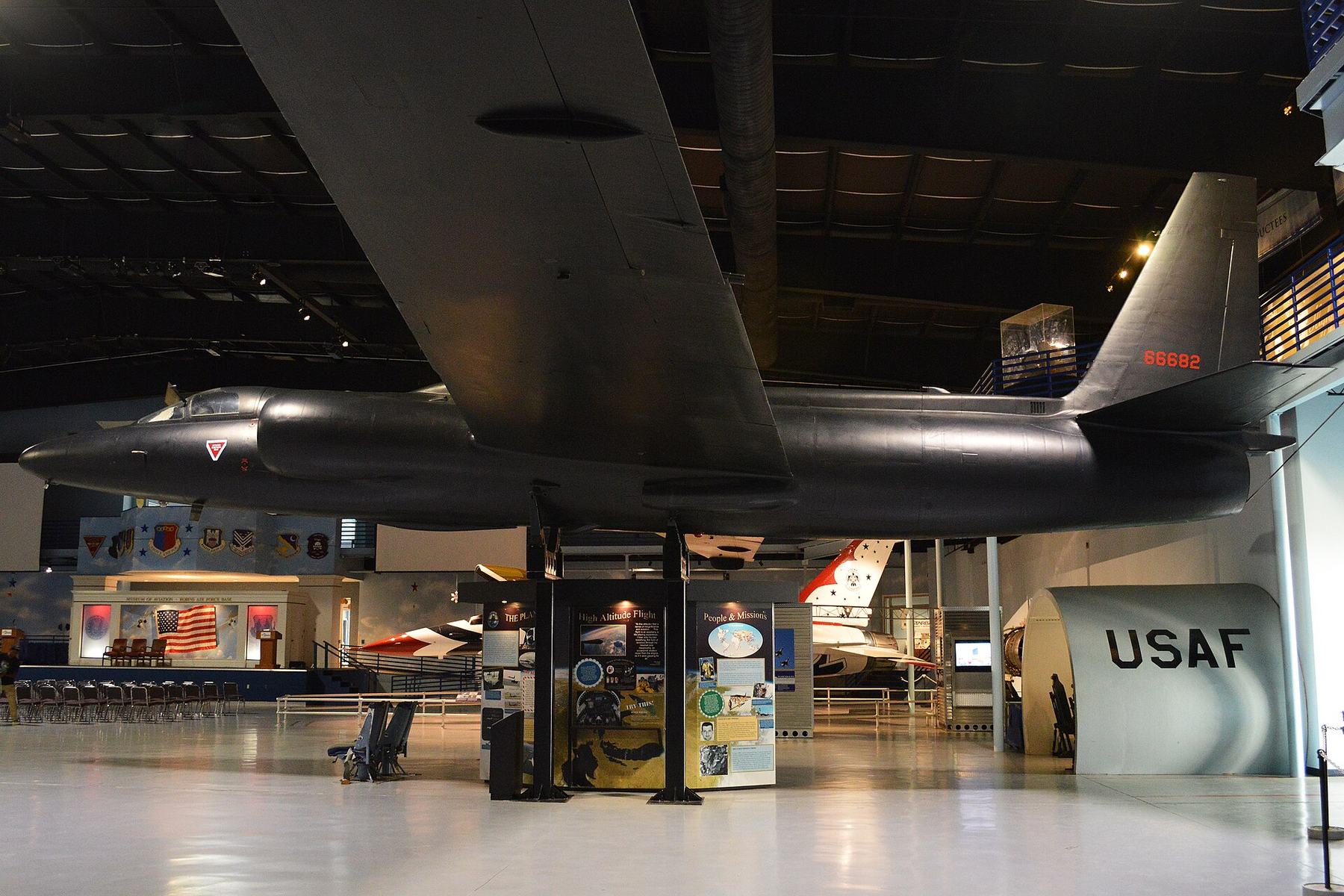
1 August 1955: the U-2's unintended takeoff
The early history of Groom Lake has a specific aviation record. According to the CIA's published account, Lockheed test pilot Tony LeVier was conducting a high-speed taxi test of the first U-2 on 1 August 1955. At approximately 70 knots, the aircraft unexpectedly became airborne. His first landing attempt was unsuccessful; a subsequent touchdown left only minor damage. The agency separately dates the first official test flight to 4 August. This entry's date therefore concerns an unintended initial flight, rather than a sighting of an alleged extraterrestrial vehicle.
Why a desert testing location was needed
The U-2 was developed for high-altitude reconnaissance during the Cold War. Testing required space, isolation and secrecy. Nevada's dry Groom Lake provided a suitable location that could be adapted for the aircraft and pilot training. The declassified program history connects the facility with development, transport arrangements, trials and identifiable personnel. That is fundamentally different from treating the base as an empty space into which any legend can be inserted. The documents establish a secret testing facility together with a specific, terrestrial engineering and intelligence mission.
How an actual aircraft could become a UFO report
The CIA's historical research explains why U-2 flights could produce unfamiliar observations. The aircraft operated at heights outside ordinary civilian aviation experience at the time. After sunset for an observer below, a high-flying aircraft could still be illuminated by sunlight. A distant bright object could therefore be difficult to reconcile with familiar assumptions about flight. The declassified history connects some reports with these operations. This is a mechanism for misinterpreting real technology, not a claim that every witness invented an experience or deliberately misled other people.
Why the “more than half” estimate needs boundaries
Historian Gerald Haines's CIA article reports a later estimate by program officials that U-2 and OXCART flights accounted for more than half of UFO reports during the late 1950s and the 1960s. It should be presented as a retrospective institutional estimate for a specified period. It is not, on this page, an independently reproduced case-by-case dataset, nor a proportion applicable to every worldwide report in every era. OXCART's later history must also not be folded into the August 1955 event. Chronological scope matters more than the rhetorical impact of a percentage.
What secrecy explains and what it cannot prove
This history supplies a real reason for withholding information about an unusual object: revealing the flight could compromise a reconnaissance program. Public explanations in that setting did not necessarily disclose the full operational context. But the existence of one concealed program cannot logically establish another program with any proposed contents. Linking an individual sighting to a U-2 requires agreement in time, location, altitude and route. Establishing extraterrestrial technology would require independent positive evidence. Documents about U-2 flight testing do not supply such evidence merely because the work was classified.
Editorial assessment: making a secret history testable
Our assessment is that Groom Lake illustrates how some unknowns change status when technically specific, dated documents become available. The decisive factor is the connection between an aircraft, a flight and an observation, rather than the reputation of the location. The published records support a history of reconnaissance development and help explain part of the surrounding rumor. They do not automatically resolve every report near the facility. For archival research, this is more useful than a universal answer: it provides a concrete mechanism that can be compared against individual cases while preserving the limits of each conclusion.


